What is BitLocker Drive Encryption?
BitLocker (officially BitLocker Drive Encryption) is a full-volume encryption feature that is available in some versions of Windows Vista and later operating system. BitLocker allows us to easily encrypt any volumes on our computer and restrict access with password or BitLocker recovery key. After a partition is encrypted with BitLocker, a lock icon overlays the partition icon, as demonstrated by Drive G in the figure below:
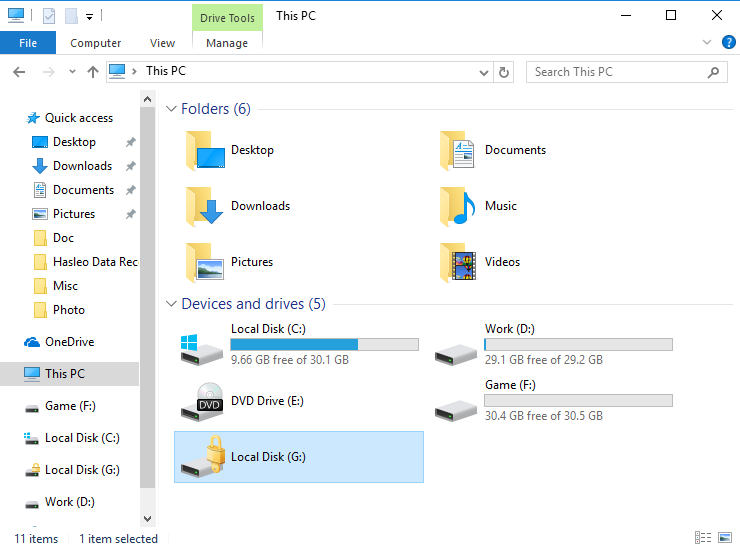
Enabling BitLocker Drive Encryption on a volume requires setting an access password, which must be entered upon every volume access. A BitLocker recovery key is also generated. You can use the recovery key to regain access to the volume when your password is forgotten. Once BitLocker is enabled, volume data becomes inaccessible without the BitLocker password or recovery key. This ensures data security even in scenarios of the computer is lost/stolen or the hard drive is transplanted to another computer.
What is BitLocker To Go?
BitLocker To Go applies BitLocker Drive Encryption technology to encrypt removable storage media (e.g., USB flash drives). Similar to BitLocker, BitLocker To Go enables encryption of removable drives (e.g., USB flash drives) with access control via either a BitLocker password or a BitLocker recovery key. Therefore, even if the device is lost, the encrypted data remains secure. The BitLocker To Go authentication workflow requires password entry upon connecting the encrypted USB drive to a Windows system. Read/write access is granted only after successful authentication.
BitLocker To Go is only available and actively recommended in Windows 7 and later operating systems. While BitLocker encryption can technically be applied to USB drives in Windows Vista, it doesn't constitute a genuine BitLocker To Go and lacks Microsoft support and recommendation. Although Windows XP/Vista does not support native BitLocker To Go, these systems retain read access to BitLocker-encrypted USB drives. During the encryption process, Windows installs a special reader on the USB drive. When you connect the encrypted USB drive to a computer running Windows XP/Vista, BitLocker To Go Reader takes control, prompts for the password, and then basically makes the USB drive a read-only device.
Frequently Asked Questions
A: BitLocker is a full-volume encryption feature available in Windows Vista and later versions. It encrypts entire drives to protect data, requiring a password or recovery key for access. Once enabled, data becomes inaccessible without proper authentication.
A: BitLocker encrypts internal hard drives, while BitLocker To Go specifically encrypts removable storage media like USB flash drives. BitLocker To Go is designed for portable devices and supports password protection for data security.
A: BitLocker is fully available in Windows 10/11 Professional, Enterprise, and Education editions. In Windows 10 Home, you can use BitLocker via third-party tools like Hasleo BitLocker Anywhere, which brings BitLocker encryption to Home users.
A: If you forgot your BitLocker password, you can use the BitLocker recovery key that was generated when you enabled encryption. The recovery key can be found in your Microsoft account, printed paper copy, or stored on another drive, depending on your backup choice.
A: While Windows XP and Vista cannot natively use BitLocker To Go, they can read encrypted drives using BitLocker To Go Reader. The encrypted USB drive becomes read-only on these older systems, allowing access with the proper password.
A: Yes, you can encrypt external hard drives using BitLocker To Go. This provides portable data protection for external storage devices, ensuring your data remains secure even if the external drive is lost or stolen.
A: If you lose your BitLocker recovery key and forget your password, the encrypted data cannot be recovered. It is crucial to store the recovery key safely in multiple locations, such as your Microsoft account, printed copy, or a secure cloud storage.
A: BitLocker has minimal performance impact on modern computers with hardware-based encryption (TPM). The encryption and decryption happen transparently during normal operations, and most users do not notice any performance difference after enabling BitLocker.
Related Articles
- How to Recover Lost Files From BitLocker Encrypted Drive?
- How to recover data from Bitlocker encrypted partition in Windows 10?
- What is BitLocker recovery key and how to find BitLocker recovery key?
- How to recover data from accidentally formatted BitLocker encrypted drive?
- How to recover deleted/lost files from BitLocker To Go encrypted USB flash drive?