- Background Knowledge
- Method 1: Enable/Turn On BitLocker in Windows 10/11 Home With Hasleo BitLocker Anywhere
- Method 2: Enable/Turn On BitLocker on another computer running Windows 10/11 Pro or Enterprise
- Method 3: Upgrade to Windows 10/11 Pro to enable/turn on BitLocker
- Frequently Asked Questions (FAQ) for Enabling BitLocker in Windows 10/11 Home
- The Bottom Line
I recently purchased a laptop computer came with Windows 10 home edition as the operating system, and I wanted to encrypt the hard drive with bitlocker. It's come to my attention that Windows 10 home edition does not enable bitlocker drive encryption. I researched for hours and tried a few different way to try and bypass this but nothing has worked. My question is: How to Turn On BitLocker in Windows 10 Home Edition? Or do I have to use a three-party software?
Background Knowledge
BitLocker is a full-disk encryption feature developed by Microsoft for Windows. It helps users encrypt volumes and prevent unauthorized access to data, making it a valuable tool for those with data protection needs. However, years after the release of Windows 10 and even with Windows 11 now available, Microsoft still has not enabled BitLocker Drive Encryption in the Home editions of either OS. This means users cannot enable BitLocker in Windows 10/11 Home by default—a significant drawback for Home edition users.
Is there any other way to enable/turn on BitLocker in Windows 10/11 Home edition? The answer is to use the three-party BitLocker solution such as Hasleo BitLocker Anywhere For Windows. Hasleo BitLocker Anywhere For Windows is a software specially designed for Windows users to help them use BitLocker in Windows Home, with it you can enable/turn on BitLocker for Windows C: drive and data volumes in Windows 10/11 Home. The BitLocker encryption algorithm implemented by Hasleo BitLocker Anywhere For Windows is fully compatible with the BitLocker encryption algorithm used by Windows 10/11, so you don't have to worry about compatibility and security issues. Please download and install the software first before heading to the next steps.
This tutorial will not only show you how to enable BitLocker in Windows 10/11 Home edition step by step using Hasleo BitLocker Anywhere, but also introduce several other methods to enable BitLocker in Windows 10/11.



Method 1: Enable/Turn On BitLocker in Windows 10/11 Home With Hasleo BitLocker Anywhere
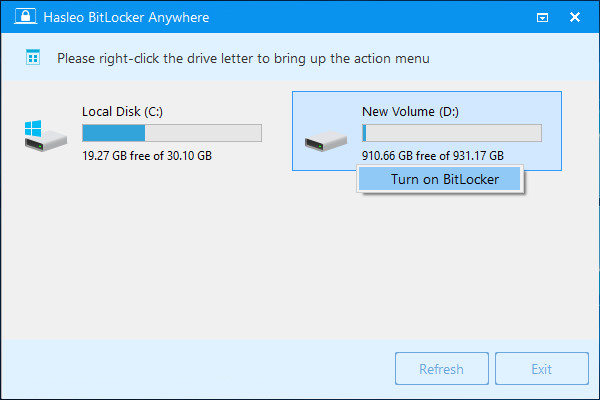
Step 1. Launch Hasleo BitLocker Anywhere For Windows, right-click the drive letter you want to encrypt, then click "Turn On BitLocker".
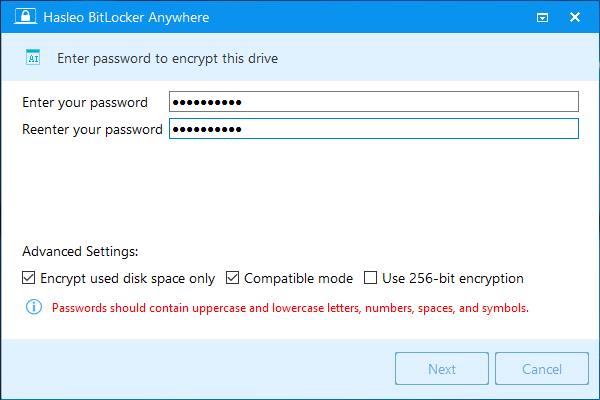
Step 2. In this step, you are required to specify a password for encrypting the drive, enter the password and click "Next". You should choose a password having a combination of upper and lower case letters, numbers, spaces, and special symbols. Once the encryption is complete, you can access the drive using this password.
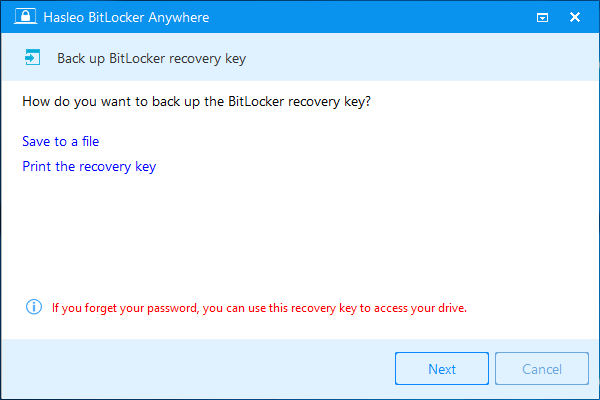
Step 3. Back up BitLocker recovery key, then click "Next" to move on. You can save the recovery key to a file or print a copy of it. Please note that anyone can use the recovery key to gain access to the drive, even if they do not know the password entered in the previous step, so please do not disclose it to others.
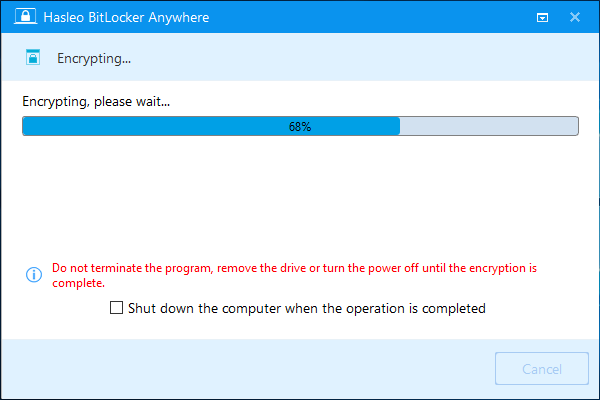
Step 4. Hasleo BitLocker Anywhere for Windows will now encrypt the selected drive using BitLocker drive encryption. The encryption process may take a long time depending on the drive size, so please be patient. If you prefer not to wait, checking the "Shut down the computer when the operation is completed" option is a good idea.
Step 5. After the encryption is complete, click the "Finish" button to close the window.
Method 2: Turn On BitLocker on another computer running Windows 10/11 Pro, Enterprise or Education
Accessing BitLocker-encrypted drives is a built-in feature of Windows 11/10. However, encrypting drives with BitLocker is not available in Windows 10/11 Home. Fortunately, this feature is included in Windows 10/11 Pro and higher editions. If you have a PC running Windows 10/11 Pro, Enterprise, or Education, simply connect the drive to that PC to encrypt it. The easiest method is to right-click the drive in Explorer, select "Turn on BitLocker", and follow the prompts.
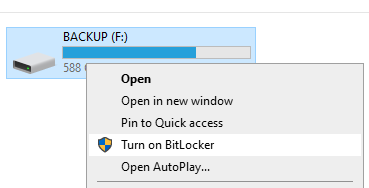
If the target drive is removable and you have access to a computer running Windows 10 Pro, Enterprise, or Education, you can disconnect the drive, encrypt it on that computer, and then reconnect it to the original computer for use. Note that this method only works if the drive can be physically disconnected from your machine.
Method 3: Upgrade to Windows 10/11 Pro to turn on BitLocker
Microsoft has built-in full-featured BitLocker in Windows 10/11 Pro and more advanced editions, so we only need to upgrade from Windows 10/11 Home to Pro to use Windows' built-in BitLocker to encrypt drives. After upgrading to a more advanced edition of Windows 10/11, you just need to encrypt the drive as described in the previous method.
We know that upgrading from Windows Home to Windows Professional costs $99, and if you have the budget, upgrading to Windows Professional is a great option.
Frequently Asked Questions (FAQ) for Enabling BitLocker in Windows 10/11 Home
A: No, Windows Home editions do not include BitLocker encryption feature. BitLocker is only available in Windows Pro, Enterprise, and Education editions. You need third-party software like Hasleo BitLocker Anywhere to encrypt drives in Windows Home.
A: You need third-party software like Hasleo BitLocker Anywhere to enable BitLocker in Windows Home. The software provides full BitLocker functionality including encrypting drives with passwords.
A: Encryption time depends on the drive size and speed. For large drives, it may take several hours. You can continue using your computer during the encryption process.
A: No, encrypting a drive does not erase your data. The encryption process converts data in place without deleting files. However, it is always recommended to back up important data before encryption as a precaution.
A: Yes, you can encrypt the system partition using Hasleo BitLocker Anywhere. However, encryption of the system partition requires rebooting into pre-OS mode to complete.
A: BitLocker uses AES encryption with 128-bit or 256-bit key lengths. It also supports XTS-AES mode for enhanced security on modern systems.
A: Yes, BitLocker-encrypted drives can be accessed across different Windows versions as long as you have the password or recovery key.
A: BitLocker encryption has minimal impact on system performance. The encryption is performed transparently during read/write operations, and most users won't notice any difference in speed.
The Bottom Line
This tutorial describes several methods to help you enable/turn on BitLocker in Windows 10/11 Home edition. If you are looking for a solution on how to enable/turn on BitLocker in Windows 10/11 Home Edition and don't have the budget to upgrade to Windows Professional, as mentioned above, Hasleo BitLocker Anywhere For Windows is the best solution you need.
If you need to decrypt a BitLocker encrypted drive in Windows 10 Home, please refer to How to Turn Off BitLocker Drive Encryption in Windows 10/11 Home?
If you need to recover lost files from a BitLocker encrypted drive, we recommend you to try professional BitLocker data recovery software Hasleo BitLocker Data Recovery.