

- Overview of Windows 7
- Why do you need to migrate Windows 7?
- Best Windows 7 Cloning Software - Hasleo Backup Suite
- Tutorial to Migrate Windows 7 to Another Disk Using Hasleo Backup Suite
- Frequently Asked Questions
- Conclusion
This tutorial describes how to use cloning software, Hasleo Backup Suite, to migrate your Windows 7.
Overview of Windows 7
Windows 7 was released on October 22, 2009, and quickly became the most popular Windows desktop operating system. However, Microsoft ended support for it on January 14, 2020. Despite this, there are still some users who insist on using it due to the fact that Windows 7 provides an easy-to-use interface, stable operation, and high performance. While you can continue using a Windows 7 computer, the absence of ongoing software and security updates exposes it to significantly higher risks from viruses and malware. Therefore, we recommend that you upgrade to Windows 10/11 for enhanced security.
Many users insist on choosing Windows 7 as the operating system for personal computers due to its stability and ease of use. Despite Microsoft's extensive efforts to encourage upgrades to Windows 10/11, most users remain unmoved. If asked to vote for Microsoft's most successful Windows desktop operating systems, Windows 7 would likely achieve the highest score.
Why do you need to migrate Windows 7?
Since the release of Windows 10, most new motherboards have discontinued support for Windows 7, making it incompatible with modern PCs. Consequently, Windows 7 now usually runs on older computers, which typically use traditional mechanical hard drives (HDDs). To improve the performance of these old computers, you can replace the old HDD with a solid-state drive (SSD). This process often involves migrating the existing Windows 7 installation to the new SSD to avoid reinstalling the operating system and applications. The same migration method applies when upgrading from a smaller drive to a larger one.
Best Windows 7 Cloning Software - Hasleo Backup Suite
While many Windows cloning tools exist in the market, Hasleo Backup Suite is an ideal choice for migrating Windows 7 to a new HDD or SSD. As a professional Windows cloning software, it offers powerful features and high-speed cloning technology, making it the best Windows 7 cloning software on the market.
Below we will detail how to migrate Windows 7 from one disk to another using Hasleo Backup Suite.
Tutorial to Migrate Windows 7 to Another Disk Using Hasleo Backup Suite
Step 1. Download, install and run Hasleo Backup Suite.

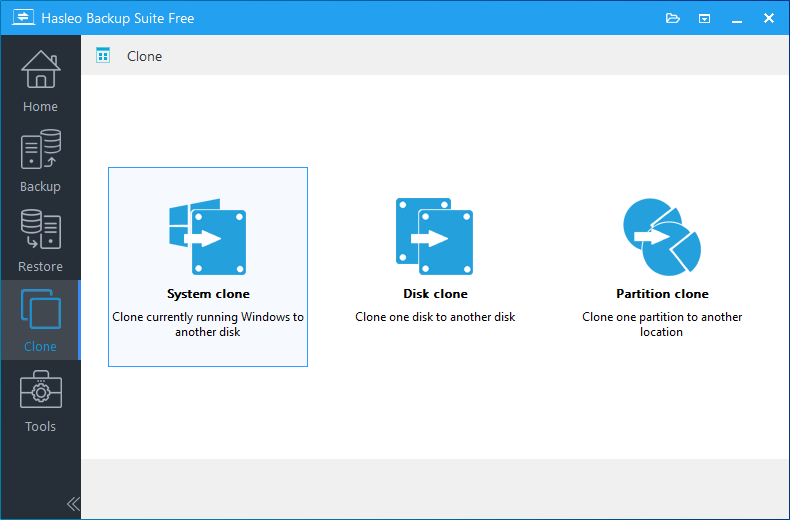
Step 2. Click the "Clone" button in the navigation bar, then click the "System clone" button in the operation area.
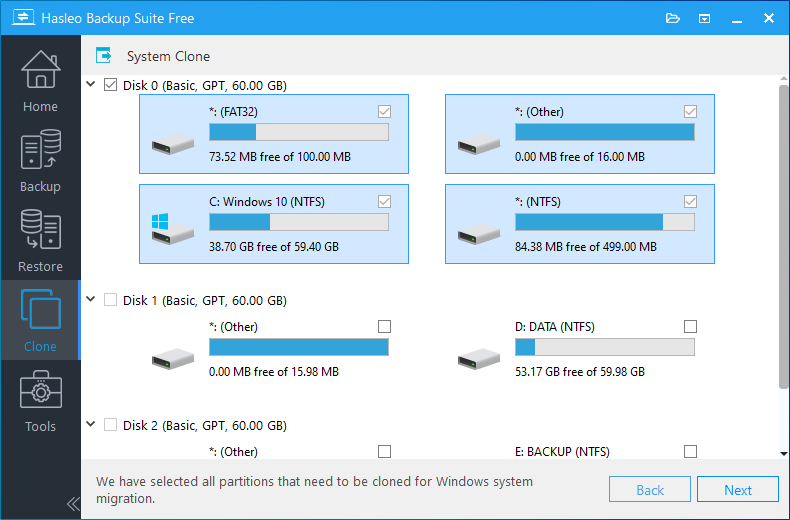
Step 3. Hasleo Backup Suite will automatically select all partitions required for Windows 7 system migration. Just click "Next" to proceed.
Step 4. Choose the destination you want to clone to, then click "Next".
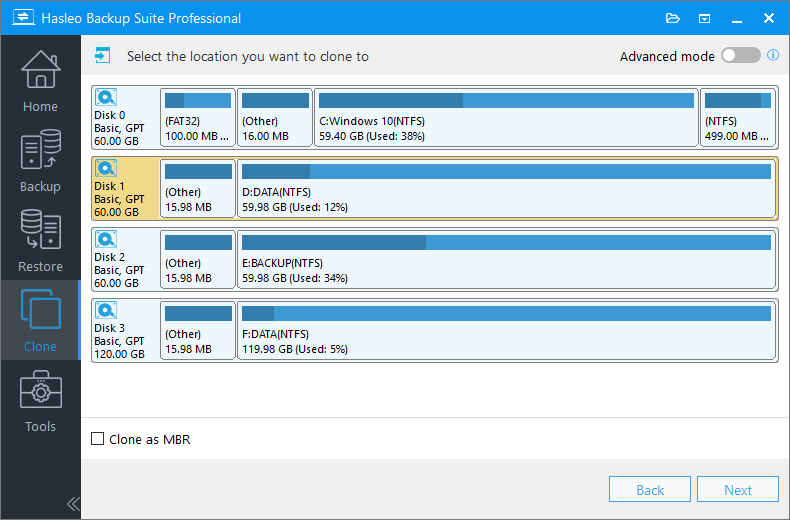
* The Keep partition layout option ensures the partition layout of the destination disk is identical to the source disk after cloning. Please note that this option is only available in "System mode".
Step 5. Adjust the size and location of the partitions according to your needs and click "Proceed". A warning message will appear, telling that all data on the destination drive will be destroyed. If the destination disk contains no important data, click "Yes" to continue.
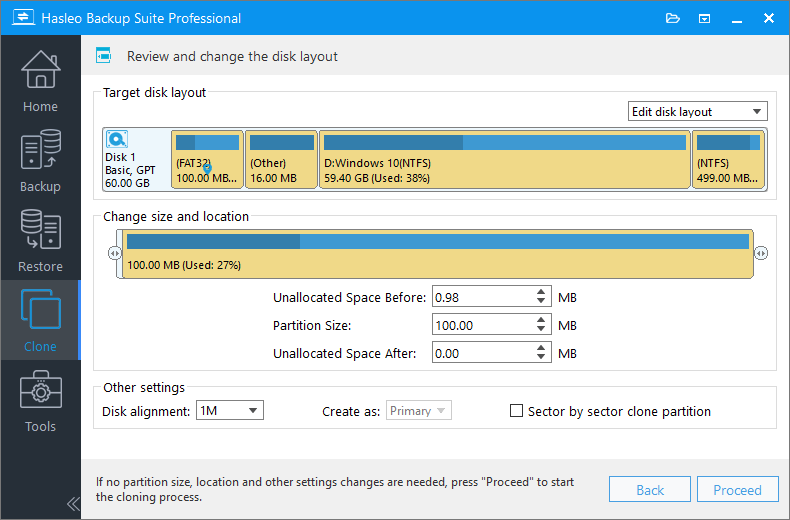
* Disk alignment:
- 1M (Recommended): 1M alignment is a subset of 4K alignment. Partitions aligned to 1MB are always 4K-aligned, which helps you get the best SSD performance. In Windows Vista and later operating systems, partitions created using Windows Disk Management are always aligned to 1MB bytes, regardless of whether the disk is an SSD.
- 4K: This option ensures the starting sector of every partition is aligned on a 4K bytes, which is very important for the best performance of an SSD.
- Cylinder: Ensure the starting sector of each destination partition always starts at the beginning of a cylinder. Windows XP and previous OSs use this alignment mode.
- None: The start sector of each the destination partitions is not aligned.
* The Sector by sector clone partiton option copies every sector from the source partition to the destination partition, including unused sectors.
Step 6. Hasleo Backup Suite starts cloning Windows 7 to the destination. Please note that the time required for cloning is related to the size of the data that needs to be cloned, so please be patient.
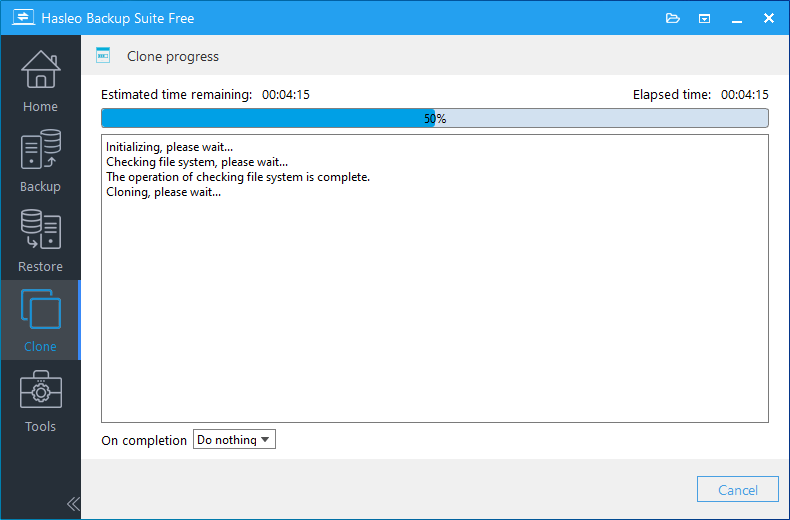
* Here you can specify a power management action to be performed after the backup is complete.
Frequently Asked Questions
A: Yes, Hasleo Backup Suite can clone Windows 7 to any SSD or HDD. Cloning to an SSD is recommended for better performance.
A: Yes, cloning will destroy all data on the destination disk. Back up important data before starting the clone process.
A: Time depends on the amount of data. A typical Windows 7 installation with applications takes 10-30 minutes.
A: No, all programs and settings are preserved during cloning. Your system will be identical after the clone completes.
A: Yes, Hasleo Backup Suite can clone Windows 7 from MBR to GPT disk or vice versa.
A: Disk alignment ensures optimal SSD performance. 1MB alignment is recommended for modern SSDs.
A: No, Microsoft ended Windows 7 support in 2020. We recommend upgrading to Windows 10/11 for security.
A: Yes, as long as the destination disk is large enough to hold all the data from the source.
Conclusion
As professional Windows cloning software, Hasleo Backup Suite allows you to migrate Windows 7 from one disk to another. It also provides comprehensive backup and restore functions for Windows 7, as well as migration tools for Windows 11/10/8 and Windows Server.
The cloning function is just one of the main features of Hasleo Backup Suite. As comprehensive Windows backup and cloning software, it also enables you to back up and restore Windows 11, 10, 8, 7.
Related Articles
- Migrate Windows Server with Best Windows Server Cloning Software
- How to Use Delta Restore in Hasleo Backup Suite to Speed Up System Restoration?
- How to Create Full/Differential/Incremental Backups in Windows Using Hasleo Backup Suite Free?
- How to back up and restore Windows 11 for free?
- How to Encrypt Backup Tasks Using Hasleo Backup Suite Free?


