- Overview of Device Encryption
- Device Encryption vs BitLocker
- Why Is Device Encryption Missing or Unavailable in Windows 11?
- How to Enable or Disable Device Encryption in Windows 11?
- Frequently Asked Questions (FAQ) for Device Encryption in Windows 11
- Conclusion
Overview of Device Encryption
The Device encryption helps protect your data, and it's available on a wide range of Windows devices. If you turn on device encryption, the data on your device can only be accessed by people who've been authorized. If device encryption isn't available on your device, you may be able to turn on BitLocker Drive Encryption instead.
Device Encryption vs BitLocker
Device Encryption and BitLocker Drive Encryption are the two encryption options available in Windows. BitLocker is only available in Windows 11 Professional and Enterprise editions, while Device Encryption is available on all Windows 11 editions. BitLocker encrypts drive data using industry-standard AES-CBC and XTS-AES algorithms, offering 128-bit and 256-bit encryption strengths to meet different security needs. Device Encryption also uses the BitLocker encryption algorithm to protect the drive. It appears to be a lightweight version of BitLocker, ensuring the same level of data security as BitLocker.
Why Is Device Encryption Missing or Unavailable in Windows 11?
If you cannot find the Device Encryption feature, or if Windows 11 displays the error "Windows Device Encryption isn't available for this device," it typically means your computer does not meet the required hardware specifications. Common reasons include:
- TPM (Trusted Platform Module) is unavailable or disabled
- PCR7 binding is not supported
- An incompatible DMA-capable device is detected
- Hardware Security Test Interface (HSTI) failed
If your computer is compatible with Device Encryption, follow the tutorial below to turn it on and protect your data. If not, and BitLocker is also unavailable, you'll need a third-party BitLocker encryption tool—we recommend Hasleo BitLocker Anywhere For Windows.



How to Enable or Disable Device Encryption in Windows 11?
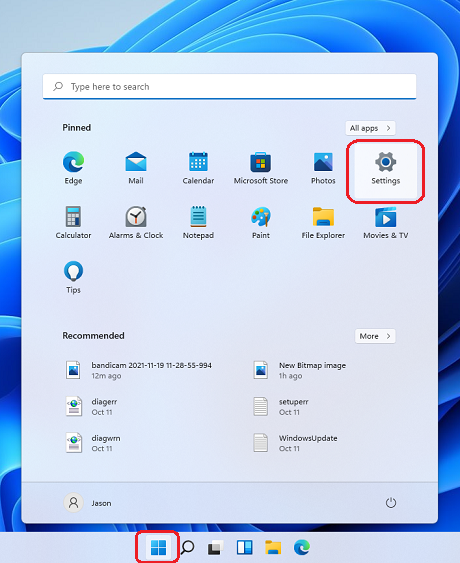
Step 1. Click the Windows icon, then click Settings.
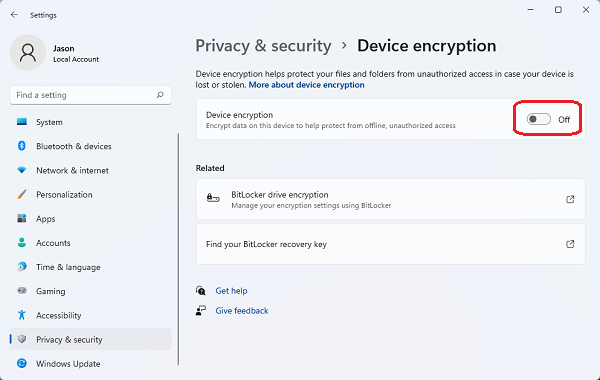
Step 2. Go to Privacy & Security > Device encryption. You can easily turn Device encryption on or off.
Step 3. Wait patiently for the encryption or decryption process to complete.
Frequently Asked Questions (FAQ) for Device Encryption in Windows 11
A: Device Encryption is a built-in Windows 11 feature that helps protect your data by encrypting the entire drive. It uses the same encryption algorithm as BitLocker to ensure data security.
A: Yes, Device Encryption is available on all Windows 11 editions, including Home, Pro, and Enterprise. This is different from BitLocker which is only available on Pro and Enterprise editions.
A: Device Encryption requires TPM (Trusted Platform Module), PCR7 binding support, and compliance with Hardware Security Test Interface (HSTI). If your computer doesn't meet these requirements, the feature may be unavailable.
A: BitLocker is only available on Windows 11 Pro and Enterprise editions. For Windows 11 Home, you can use third-party software like Hasleo BitLocker Anywhere as an alternative.
A: Device Encryption has minimal impact on system performance. The encryption is performed transparently during read/write operations, and most users won't notice any difference in speed.
A: Go to Settings > Privacy & Security > Device encryption. If you see the Device encryption option with a toggle switch, it means your computer supports the feature.
A: No, turning off Device Encryption does not erase your data. It simply removes the encryption protection, making your data accessible without authentication.
A: Device Encryption uses the same BitLocker encryption algorithm to protect your data, but it appears to be a lightweight version. BitLocker offers more advanced management features and is only available on Pro and Enterprise editions.
Conclusion
This tutorial describes how to turn on or off device encryption in Windows 11. If your computer does not support the device encryption feature, you can turn on BitLocker instead to encrypt your data.