

Disk clone completely copies the contents of one disk to another disk, including the partition structure and the files in the partitions. It is mainly used to upgrade or replace a disk, such as replacing a mechanical hard disk with an SSD or upgrading a small capacity disk to a large capacity disk. Of course, it can also be used for disk backup purposes. In addition, the Disk clone feature allows you to clone an MBR disk into a GPT disk or vice versa.
Tutorial to clone disk with Hasleo Backup Suite.
Before you begin
Make sure the following requirements are met before you start cloning:
✦ Sufficient destination space: All used space on the source disk must fit on the destination disk. Cloning to a smaller SSD is fine as long as the used data fits.
✦ Back up important data: All data on the destination disk will be overwritten. If it contains files you need, back them up first.
✦ Connect the destination disk: Make sure the target disk is connected to the computer and detected by Windows, whether it is an internal SATA/NVMe drive or an external USB disk.
✦ Download and install Hasleo Backup Suite:

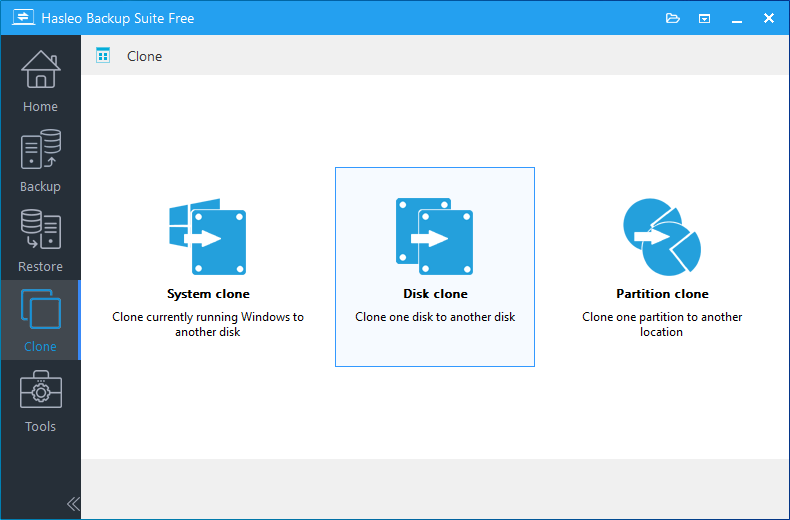
Step 1. Install and run Hasleo Backup Suite, click "Clone" button in the navigation bar, then click "Disk Clone" button in the operation area.
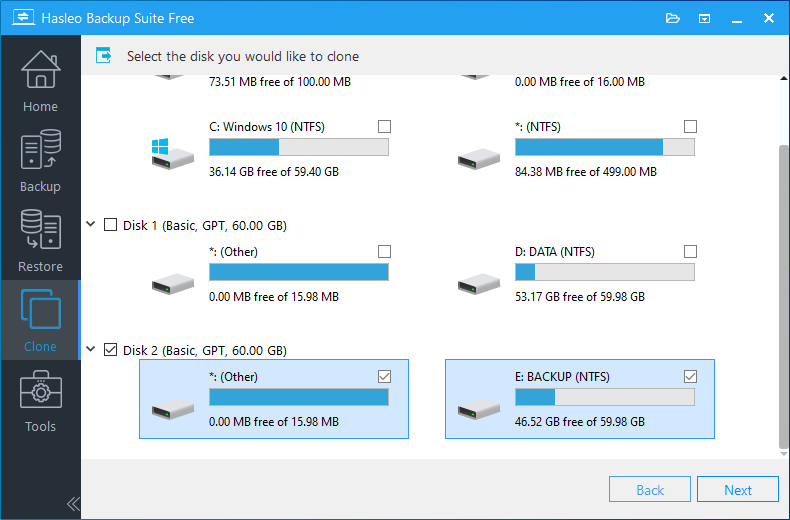
Step 2. Select the source disk you want to clone, then click "Next".
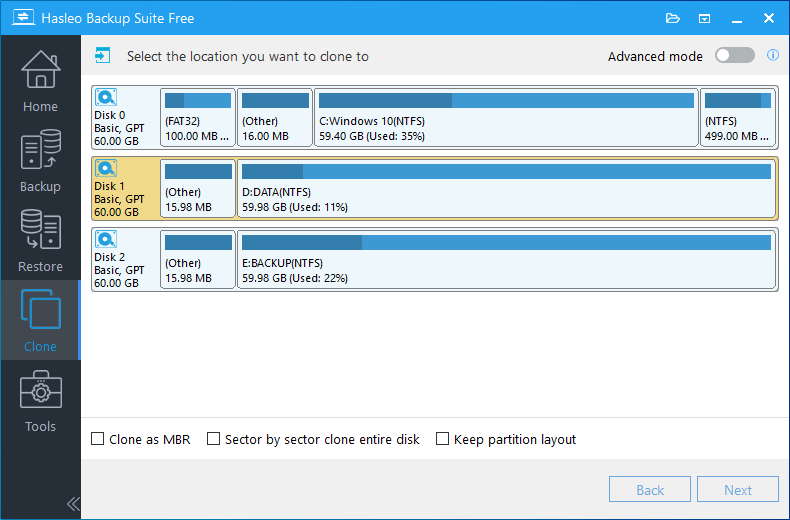
Step 3. Choose the location you want to clone the disk to, Hasleo Backup Suite provides two ways: Normal mode and Advanced mode.
Normal mode: Clone disk to the destination disk and all partitions on the destination disk will be destroyed. You just need to select the destination disk you want to clone to, then click "Next".
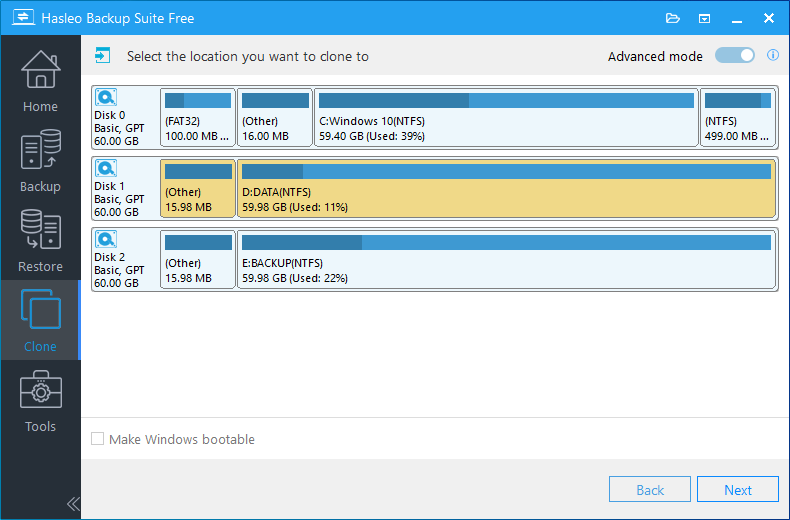
Advanced mode: Clone disk to a contiguous space (it can be a combination of multiple existing partitions and free space) on the destination disk and keep other unselected partitions that exist on the destination disk. Please enable "Advanced mode" and select the contiguous space you want to clone the disk to on the destination disk, then click "Next".
2. The Sector by sector clone entire disk option enables you to clone all sectors from source disk to destination disk, so the capacity of the destination disk should be equal to or greater than the capacity of the source disk.
3. The Keep partition layout option can ensure that the partition layout of the destination disk is exactly the same as the source disk after the cloning operation is completed.
Step 4. Adjust the size and location of the partitions according to your needs, then click "Proceed". A warning message may pop up to tell you that all data on the destination drive will be destroyed, click the "Yes" to continue if you do not have important data on the destination disk.
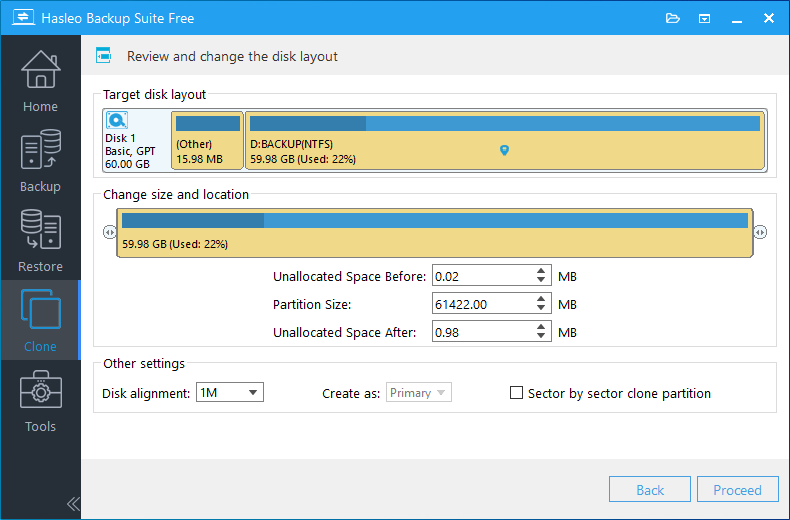
4K: This option ensures the starting sector of every partition is aligned to 4K bytes, which is very important for the best performance of an SSD.
Cylinder: Ensure the starting sector of each destination partition always starts at the beginning of a cylinder. Windows XP and previous OSs use this alignment mode.
None: The start sector of each of the destination partitions is not aligned.
The Sector by sector clone partiton option enables you to clone all sectors from source partition to destination partition.
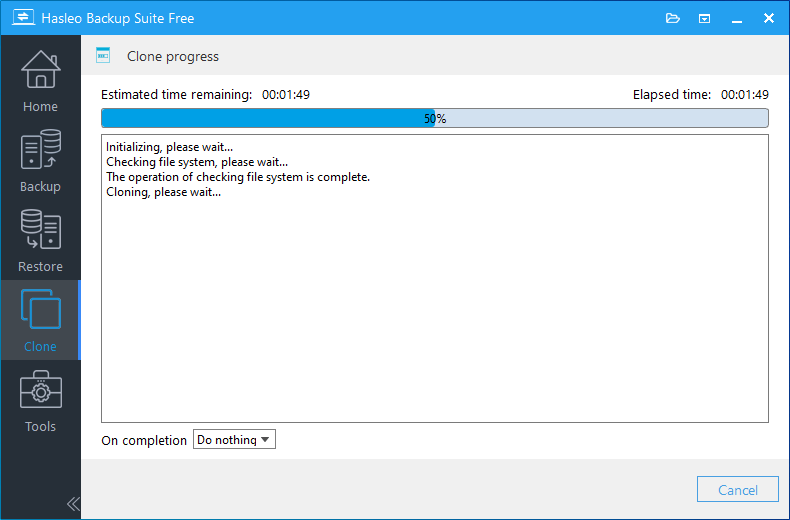
Step 5. Hasleo Backup Suite starts cloning the source disk to the destination disk. Please note that the time required for disk cloning is related to the size of the data that needs to be cloned, so please be patient.
Frequently Asked Questions
A: Depends on data size and disk speed. A 500GB SSD to HDD clone takes 10-20 minutes. Larger disks or HDDs take longer.
A: Only if the smaller disk has enough capacity for all used data. The destination must hold all files from source.
A: 1M alignment (recommended) works best for all SSDs. Use 4K for older drives if needed. Cylinder is outdated.
A: Yes. Use "Clone as MBR" or "Clone as GPT" option during cloning. The target partition scheme converts automatically.
A: No. Cloning copies everything—OS, apps, settings—for an exact copy. Just change boot order in BIOS to boot from new disk.
A: Normal mode overwrites entire destination disk. Advanced mode clones to free space while keeping other partitions.
A: Only for forensic purposes or to recover deleted files. It copies unused sectors and takes much longer.
A: Yes, but for best results, boot into WinPE using emergency disk. This ensures no files are in use during cloning.


