- Overview of VeraCrypt
- Best VeraCrypt Alternative in Windows Home - Hasleo BitLocker Anywhere
- How to Protect Data with Hasleo BitLocker Anywhere, the Best VeraCrypt Alternative, in Windows 11/10/8.1/8/7 Home & Windows 7 Pro
- Frequently Asked Questions (FAQ) for VeraCrypt Alternative
- Conclusion
Overview of VeraCrypt
After the TrueCrypt TrueCrypt project suddenly announced the discontinuation of its development and maintenance, IDRX developed VeraCrypt based on TrueCrypt 7.1a. VeraCrypt adds enhanced security to the algorithms used for system and partition encryption, making it immune to new developments in brute-force attacks. VeraCrypt also resolves many vulnerabilities and security issues found in TrueCrypt. Even so, some users remain skeptical about its security because VeraCrypt is based on TrueCrypt's source code, and TrueCrypt stopped development for security reasons. If you are reading this and currently using VeraCrypt, do you share the same concerns? Are you also looking for a reliable VeraCrypt alternative to protect your data on Windows 11/10/8.1/8/7 Home and Windows 7 Pro? When TrueCrypt was discontinued, its developers recommended that users encrypt their drives using Microsoft's BitLocker Drive Encryption. Therefore, BitLocker can serve as a viable VeraCrypt alternative.
Best VeraCrypt Alternative in Windows Home - Hasleo BitLocker Anywhere
BitLocker is a built-in full disk encryption feature in Windows that helps protect your data by encrypting drives. If you trust Microsoft and need drive encryption, BitLocker itself is a solid choice. However, the partition encryption functionality is not available in Windows 11/10/8.1/8/7 Home editions or Windows 7 Professional. For users on these editions, a third-party BitLocker solution is required. We recommend Hasleo BitLocker Anywhere—the world's first third-party BitLocker solution fully compatible with Microsoft's BitLocker encryption algorithm. It enables you to encrypt drives, decrypt drives, change passwords, and more, all within Windows Home and Windows 7 Pro editions.



How to Protect Data with Hasleo BitLocker Anywhere, the Best VeraCrypt Alternative, in Windows 11/10/8.1/8/7 Home & Windows 7 Pro
Step 1. Download and install Hasleo BitLocker Anywhere.
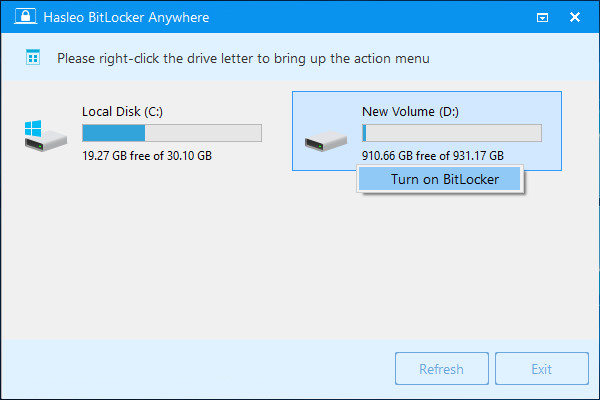
Step 2. Launch Hasleo BitLocker Anywhere, right-click the drive letter you want to encrypt, then click "Turn On BitLocker".
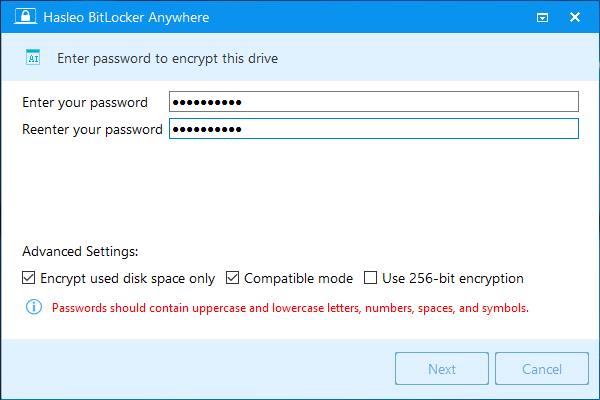
Step 3. In this step, you are required to specify a password for encrypting the drive, enter the password and click "Next". You should choose a password having a combination of upper and lower case letters, numbers, spaces, and special symbols. Once the encryption is complete, you can access the drive using this password.
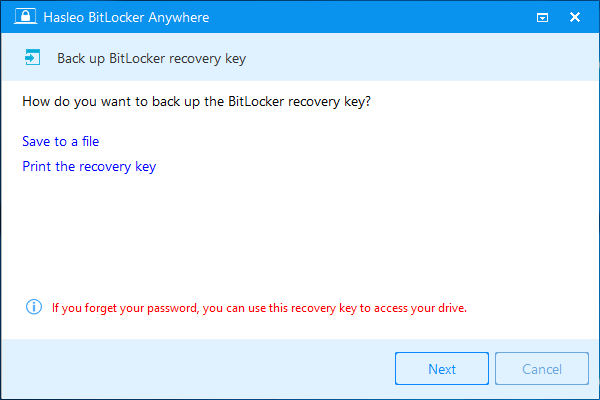
Step 4. Back up BitLocker recovery key, then click "Next" to move on. You can save the recovery key to a file or print a copy of it. Please note that anyone can use the recovery key to gain access to the drive, even if they do not know the password entered in the previous step, so please do not disclose it to others.
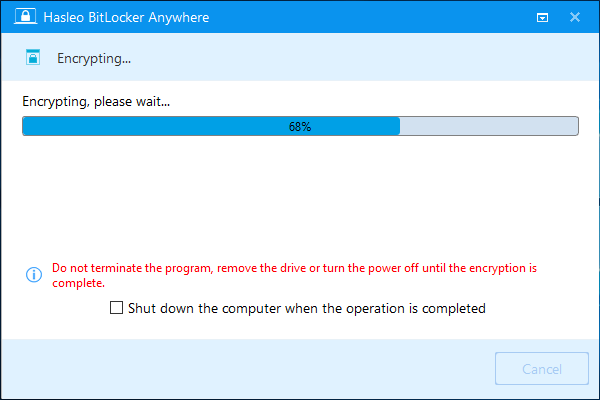
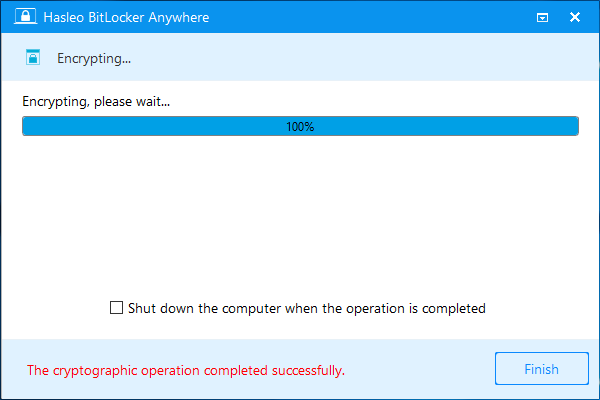
Step 5. Hasleo BitLocker Anywhere will now encrypt the contents of the selected drive using BitLocker drive encryption. The encryption process could take a long time to finish depending on the size of the drive, so please be patient to wait. If you don't want to wait until the encryption operation is finished, "Shut down the computer when the operation is completed" option is a good idea. Just check it.
Step 6. After the encryption is complete, click the "Finish" button to close the window.
Frequently Asked Questions (FAQ) for VeraCrypt Alternative
A: VeraCrypt is generally considered safe. It added enhanced security over TrueCrypt and fixed many vulnerabilities. However, some users remain skeptical because it is based on TrueCrypt's code, which was discontinued for security reasons.
A: Hasleo BitLocker Anywhere is the best VeraCrypt alternative. It brings full BitLocker support to Windows Home editions where BitLocker is not natively available.
A: VeraCrypt containers cannot be directly migrated to BitLocker. You need to decrypt the VeraCrypt volume first, then encrypt the same drive with BitLocker using Hasleo BitLocker Anywhere.
A: No, BitLocker uses AES by default with TPM protection, while VeraCrypt uses its own algorithm with a password-based key derivation. However, both provide strong encryption.
A: BitLocker is typically faster because it uses hardware-accelerated encryption (AES-NI) available in modern CPUs. VeraCrypt may be slower on some systems.
A: Yes, you can use both on different drives. VeraCrypt creates container files or encrypts partitions differently from BitLocker, which encrypts entire volumes at the disk level.
A: Your data remains safe during migration. Simply decrypt the VeraCrypt volume first, then encrypt the drive with BitLocker. No data loss occurs during the process.
A: BitLocker offers better Windows integration, hardware acceleration, and enterprise management. VeraCrypt offers more encryption algorithm choices. BitLocker is recommended for Windows users.
Conclusion
To sum it up, Hasleo BitLocker Anywhere is the best VeraCrypt alternative for Windows. It helps you encrypt drives to protect data on Windows 11/10/8.1/8/7 Home and Windows 7 Pro, while also supporting BitLocker drive decryption, password changes, recovery key export, and more.
Related Articles
- How to Enable BitLocker in Windows 10 Home Edition?
- Best full disk encryption software for Windows Home!
- Best TrueCrypt Alternative for Windows 11/10/8/7 Home & 7 Pro!
- Best Alternative to iSunshare BitLocker Genius for Windows!
- How to Protect Data with Best BitLocker Alternative in Windows 11/10/8.1/8/7 Home?