I have a new laptop running windows 10 Home and am trying to ensure Windows C: drive is BitLocker protected. When using the manage-bde.exe command line utility to check the status of the OS volume, I get the following output:
C:\WINDOWS\system32>manage-bde.exe -status C:
BitLocker Drive Encryption: Configuration Tool version 10.0.19041
Copyright (C) 2013 Microsoft Corporation. All rights reserved.
Volume C: [Windows 10]
[OS Volume]
Size: 200.40 GB
BitLocker Version: None
Conversion Status: Used Space Only Encrypted
Percentage Encrypted: 100.0%
Encryption Method: XTS-AES 128
Protection Status: Protection Off
Lock Status: Unlocked
Identification Field: Unknown
Key Protectors: None Found
The drive seems to have been encrypted by BitLocker, but the protection has been turned off because there is no protector available, so the drive is not protected. I tried to use manage-bde.exe to add a password protector to the drive, but I got the following output:
C:\Windows\system32>manage-bde.exe -protectors -add c: -pw
BitLocker Drive Encryption: Configuration Tool version 10.0.21996
Copyright (C) 2013 Microsoft Corporation. All rights reserved.
Type the password to use to protect the volume:
Confirm the password by typing it again:
Key Protectors Added:
ERROR: An error occurred (code 0x8031005a):
This version of Windows does not support this feature of BitLocker Drive Encryption. To use this feature, upgrade the operating system.
The question I want to ask is: Is there a way to encrypt a partition whose protection status is "Protection Off" without upgrading Windows?
If you recently purchased a computer with Windows 10 Home Edition, you may notice that the C: drive appears BitLocker-encrypted, but with "Protection Off" and no protector available. Because the built-in BitLocker in Windows 10 Home Edition lacks full functionality, you cannot add protectors or turn on protection for such partitions. Hasleo BitLocker Anywhere, the world's first third-party BitLocker solution for Windows Home Edition, solves this. It allows you to add protectors and change the status to "Protection On" for partitions currently showing "Protection Off."



How to Encrypt a Partition with "Protection Off" Status?
Step 1. Download and install Hasleo BitLocker Anywhere.
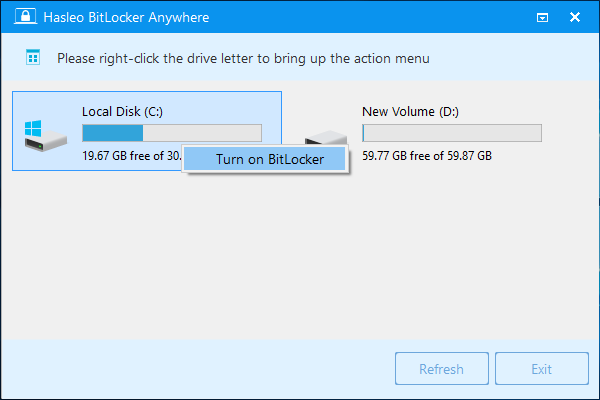
Step 2. Launch Hasleo BitLocker Anywhere, right-click the drive letter, then click "Turn On BitLocker".
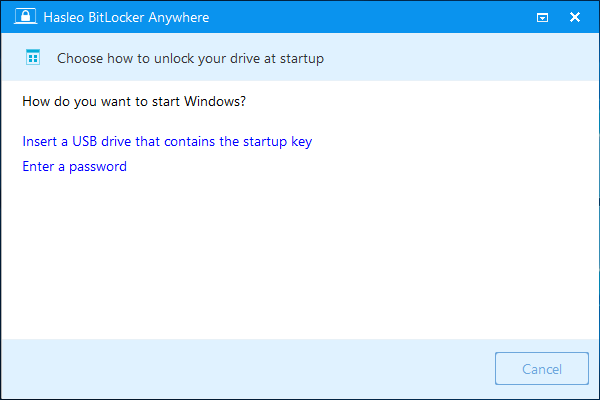
Step 3. If the partition you want to encrypt is a Windows partition (C: drive), you will be asked to choose how to unlock the Windows drive at startup, you can choose to enter a password or insert a USB flash drive each time you start your PC. If the partition to be encrypted is not a Windows partition, you will be directly asked to enter the encryption password.
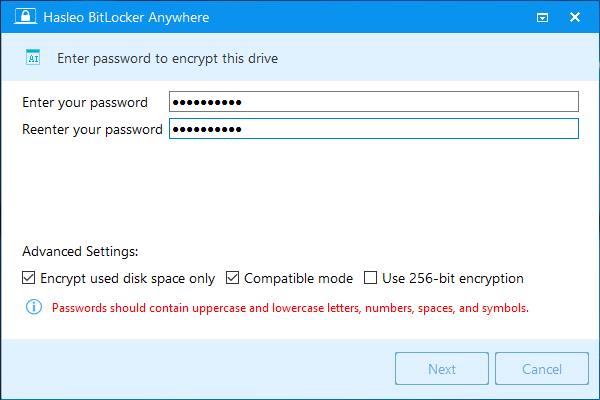
If you choose to enter a password at startup, you are required to specify a password for encrypting the drive, enter the password and click "Next". You should choose a password having a combination of upper and lower case letters, numbers, spaces, and special symbols.
If you choose to insert a USB flash drive at startup, you are required to specify a USB drive to save the startup key, select a USB drive and click "Next".
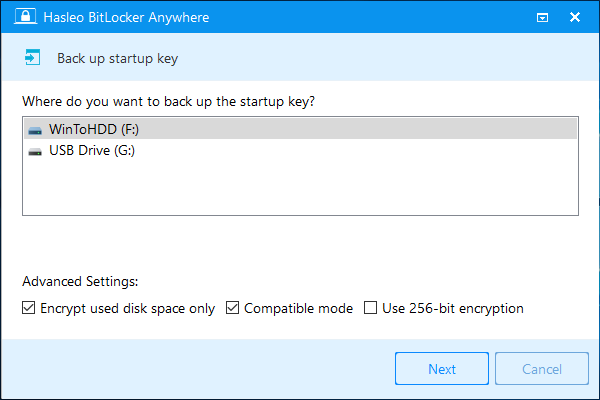
- Encrypt used disk space only: Encrypts only the space currently used by the drive's file system. Unused space remains unencrypted. This option saves time during the encryption process. After you encrypt a drive with this option, any files you add to the drive are automatically encrypted.
- Compatible mode: If the drive you plan to encrypt needs to be used on Windows operating systems prior to Windows 10 Version 1511, choose compatible mode. Windows 10 Version 1511 introduced a new disk encryption mode (XTS-AES) that is not compatible with older versions of Windows. The compatible mode (AES-CBC) is fully compatible with older versions of Windows.
- Use 256-bit encryption: BitLocker supports 128-bit and 256-bit encryption strengths. 256-bit encryption is more secure but consumes more CPU resources. Choose the encryption strength based on your needs. Select this checkbox if you want to use 256-bit encryption strength.
Step 4. After clicking "Next", you are asked how you want to backup the BitLocker recovery key. You can save the recovery key to a file or print a copy of it, then click "Next" to move on. Please note that anyone can use the recovery key to gain access to the drive, even if they do not have the startup key or password created in the previous step, so please do not disclose it to others.
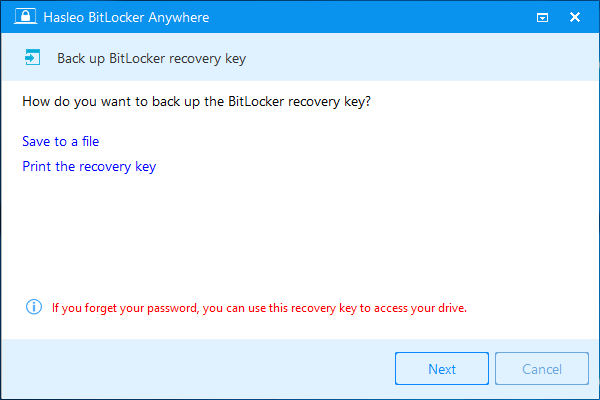
Please note that if the partition to be encrypted is a Windows partition or the partition is currently being used by other programs, Hasleo BitLocker Anywhere may prompt that the program needs to reboot into Pre-OS to encrypt the drive, just follow the prompts.
Step 5. Hasleo BitLocker Anywhere will now encrypt the contents of the drive. Since the content of the partition has actually been encrypted, Hasleo BitLocker Anywhere only changes the protection status from Off to On, so the encryption usually takes a few seconds to complete.
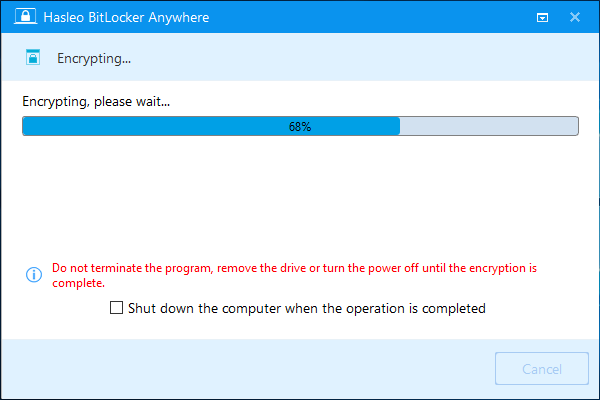
Step 6. After the encryption is complete, click the "Finish" button to close the window.
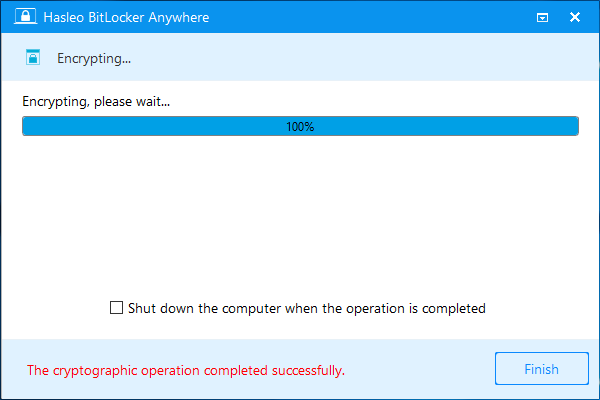
As described above, you can add protectors to a BitLocker drive with "Protection Off" status and change it to "Protection On" using Hasleo BitLocker Anywhere. Please note that this method applies not only to Windows 10 but also to Windows 8 and Windows 7.
Frequently Asked Questions (FAQ) for BitLocker Protection Off Status
A: Protection Off means the drive content is encrypted but there is no protector (password, TPM, or startup key) assigned, so the drive is not actually protected. Anyone can access the data without authentication.
A: Windows Home Edition lacks full BitLocker functionality. Some new computers come with pre-encrypted drives, but Home Edition cannot add protectors to enable protection. You need third-party software like Hasleo BitLocker Anywhere to add protectors.
A: Yes, you can use Hasleo BitLocker Anywhere to add protectors (password or startup key) to the drive and change the status from 'Protection Off' to 'Protection On' without upgrading Windows.
A: No, since the drive content is already encrypted, Hasleo BitLocker Anywhere only needs to add the protector and change the status. This process takes only a few seconds and does not affect your data.
A: A password protector requires you to enter a password each time you start the computer. A startup key protector requires you to insert a USB flash drive containing the key. The startup key is more convenient but requires you to carry the USB drive.
A: Yes, once you add a protector and enable protection, you can access the drive on any Windows 7 or later computer by entering the password or using the startup key.
A: Exactly. The data is encrypted but without a protector, the encryption provides no real security. Anyone who has physical access to the drive can read the data without any authentication.
A: If you turn on protection without properly backing up the recovery key and then lose both password and recovery key, you will lose access to the data permanently. Always back up the recovery key during the encryption process.
Related Articles
- How to Enable BitLocker in Windows 10 Home Edition?
- How to Encrypt Drive in Windows 11/10/8/7 Home & Windows 7 Pro?
- How to Encrypt Windows Partition With BitLocker in Windows 7 Pro?
- How to Encrypt Windows 7 and Start BitLocker Encrypted Windows 7 with a Password?
- Best TrueCrypt Alternatives to Safeguard Your Data in Windows 11/10/8.1/8/7 Home!