

- Overview of BitLocker
- Choose BitLocker Data Recovery Software to Recover Lost Data
- How to Recover Data From a BitLocker-Encrypted Drive in Windows 11/10.
- Frequently Asked Questions
- Conclusion
I have a BitLocker encrypted partition on my Windows 10 computer, and now I can't unlock this partition with the correct BitLocker password and BitLocker recovery key. I tried some data recovery software, but none of them helped me recover data from the BitLocker encrypted partition. My question is: how to recover data from BitLocker encrypted drive in Windows 10?
Overview of BitLocker
BitLocker is a disk encryption feature introduced by Microsoft in Windows Vista. Windows 7, 8, and 8.1 use the AES-CBC 128/256-bit encryption algorithm. Early versions of Windows 10 (prior to Version 1511) used the same algorithm. Starting with Windows 10 Version 1511, Microsoft introduced a new encryption algorithm: XTS-AES 128/256-bit, which offers enhanced security but is not compatible with older Windows versions and makes data recovery more challenging. As an enterprise-grade feature, BitLocker is natively available only in Windows Pro and Enterprise editions. If you are running Windows Home edition, you can use Hasleo BitLocker Anywhere to enable BitLocker encryption on your drives.
Choose BitLocker Data Recovery Software to Recover Lost Data
A BitLocker-encrypted partition that was previously accessible may suddenly become inaccessible, often due to file system corruption. In such cases, you can first try running chkdsk to repair file system errors, then check whether the drive becomes accessible again. Because chkdsk modifies data while repairing errors, it is strongly recommended to back up the BitLocker-encrypted drive beforehand using disk backup software such as Hasleo Backup Suite. If the drive remains inaccessible after repairing file system errors, you will need professional BitLocker data recovery software to recover lost data from the drive. Hasleo BitLocker Data Recovery is a reliable solution specifically designed for this purpose.
As a professional recovery solution, Hasleo BitLocker Data Recovery supports data recovery from BitLocker-encrypted drives - whether encrypted with AES-CBC 128/256-bit or XTS-AES 128/256-bit on Windows 11/10 - even if the drive is formatted, inaccessible, failed, damaged, lost, or deleted.
How to Recover Data From a BitLocker-Encrypted Drive in Windows 11/10 with Hasleo BitLocker Data Recovery.
Step 1: Download, install, and run Hasleo BitLocker Data Recovery

Step 2: Select a Location to Scan
1. Select the hard drive or partition where you lost your files in Windows 11/10, then click the "Scan" button to locate all BitLocker-encrypted partitions on the device.
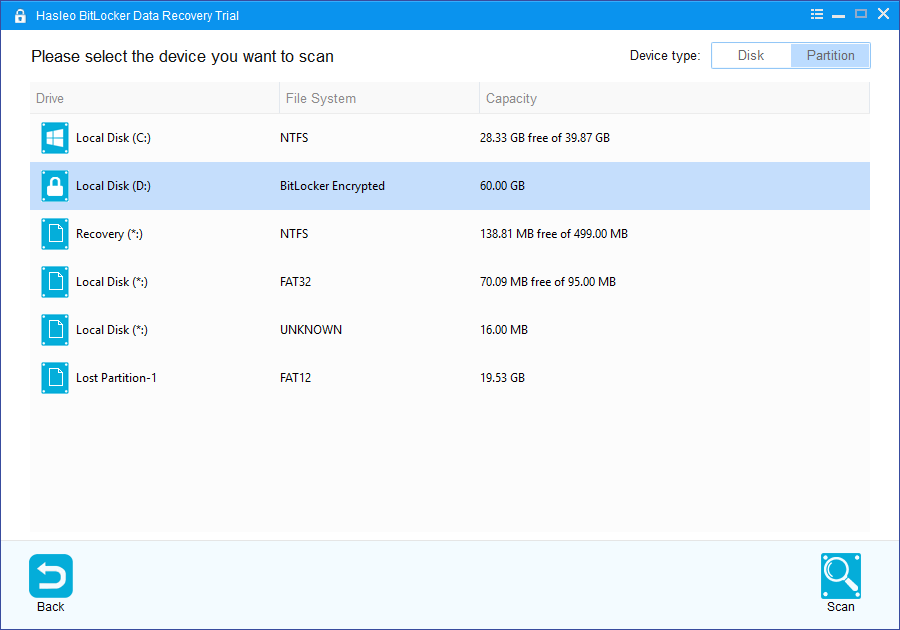
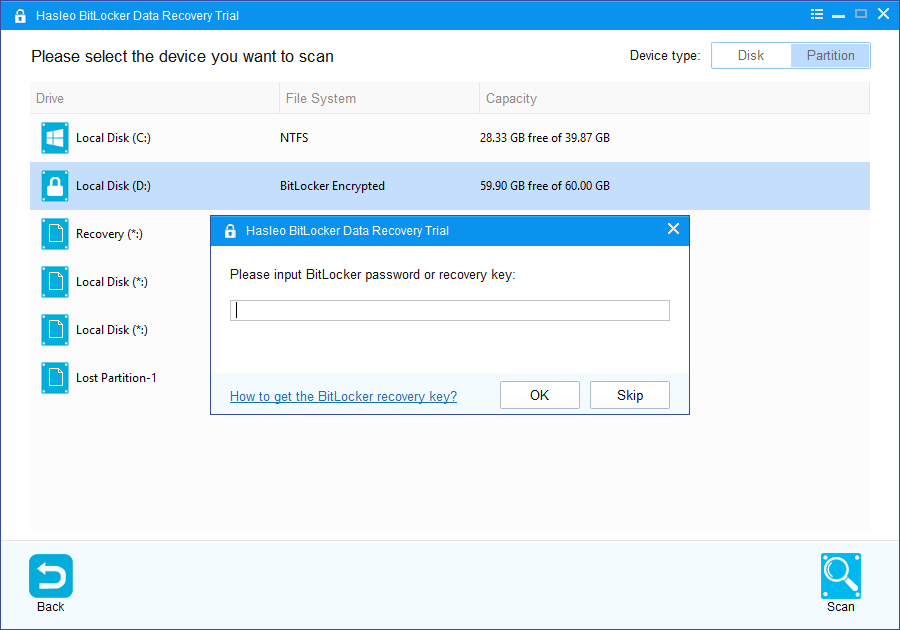
2. A pop-up window will appear asking you to enter the BitLocker password or 48-digit BitLocker recovery key. If you don't want to enter the password or BitLocker recovery key here, just click the "Skip" button to skip it.
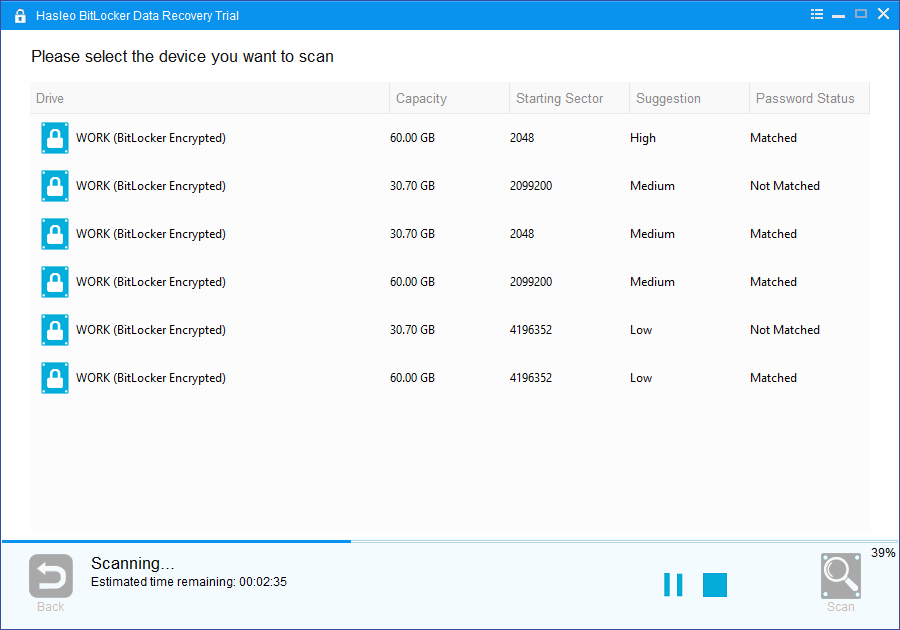
3. Hasleo Data Recovery will list all found BitLocker encrypted partitions on the target device. If you have entered the password or BitLocker recovery key in the previous step, the password status will show whether the password or BitLocker recovery key matches this partition.
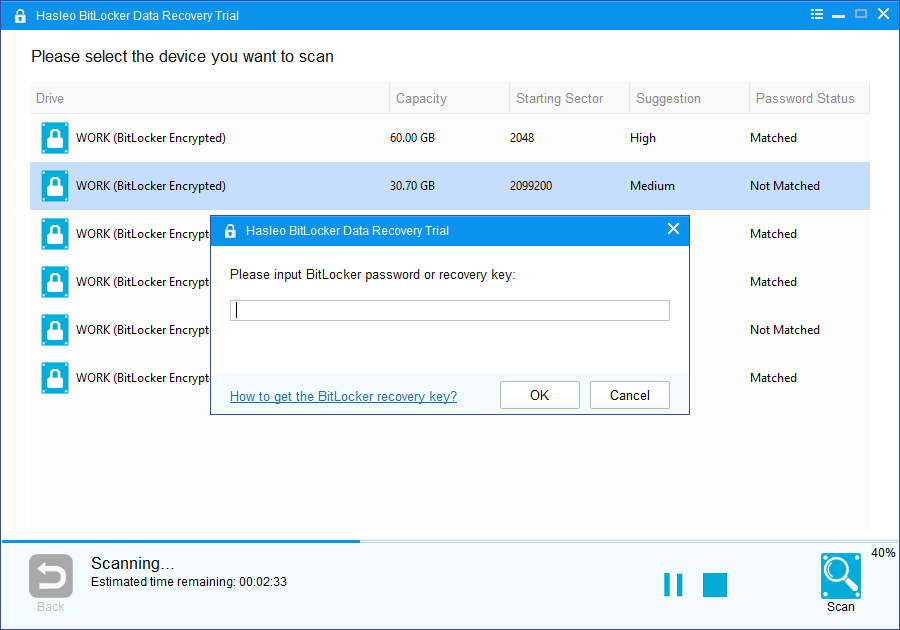
4. Double-click the partition you want to recover data from. If you've already entered the password or BitLocker recovery key and the password or recovery key matches, Hasleo Data Recovery will start scanning lost files. Otherwise, a prompt will appear asking for your BitLocker password or 48-digit recovery key. After entering the correct credentials and clicking "OK", the scan will start.
Step 3: Preview and Recover Deleted Files
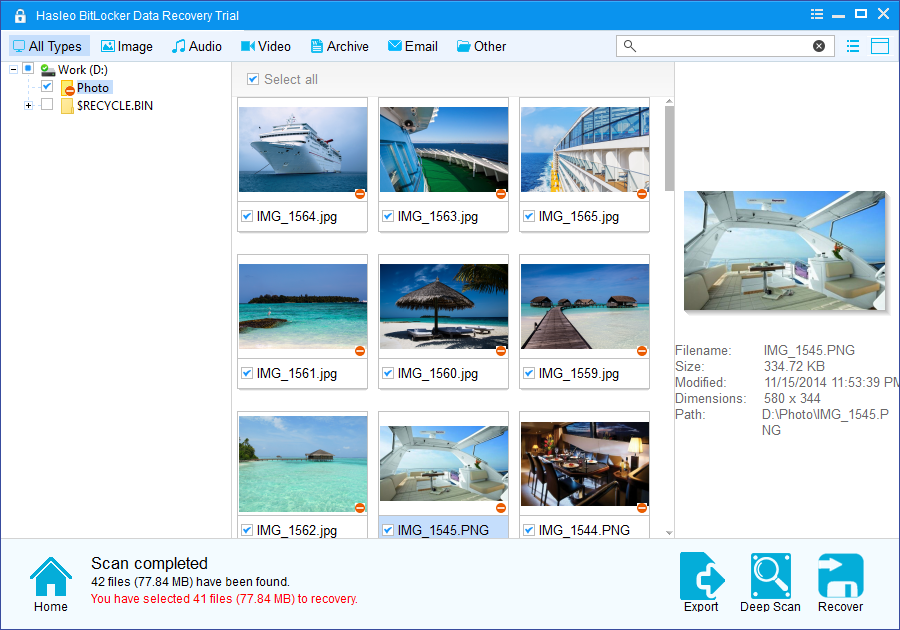
When the scanning process gets finished, you can filter and preview found files by path and file types. When you locate the files you want, just select them and click on "Recover" button to save them to your hard drive or other storage device. If some files are not found, please click "Deep Scan" button to start the Deep Scan Recovery process, deep scan takes more time, but can find much more lost files.
Frequently Asked Questions (FAQ) for BitLocker Data Recovery in Windows 10/11
A: Windows 10/11 uses XTS-AES 128/256-bit encryption (from Version 1511 onwards), which offers enhanced security compared to older AES-CBC algorithm used in Windows 7/8.
A: BitLocker drives may become inaccessible due to file system corruption, password changes, recovery key mismatches, or hardware issues. Try running chkdsk to repair file system errors first.
A: Yes, Hasleo BitLocker Data Recovery supports both AES-CBC and XTS-AES encryption algorithms used in Windows 10/11, allowing you to recover data from any BitLocker-encrypted drive.
A: BitLocker is only available in Windows Pro and Enterprise editions. For Windows Home users, you can use Hasleo BitLocker Anywhere to enable BitLocker encryption on your drives.
A: Yes, you can first try running chkdsk to repair file system errors and check if the drive becomes accessible again. However, backup the drive first if possible, as chkdsk modifies data during repair.
A: Yes, Hasleo BitLocker Data Recovery can recover data from BitLocker-encrypted USB drives, external hard drives, and Thunderbolt drives in Windows 10/11.
A: If you forgot your BitLocker password, you can use the 48-digit recovery key. The key can be found in your Microsoft account, printed paper, USB drive, or your organization's IT department.
A: Quick scan is faster and finds recently deleted files, while deep scan takes more time but performs a thorough search to find many more lost files from BitLocker-encrypted partitions.
Conclusion
Hasleo BitLocker Data Recovery is a professional BitLocker data recovery software that helps you retrieve data from BitLocker-encrypted drives in Windows 11 and 10 - whether the drive is formatted, inaccessible, damaged, lost, or deleted.
Please note that with Hasleo BitLocker Data Recovery, you can recover data not only from BitLocker encrypted internal disks, but also recover data from a BitLocker encrypted USB drive or recover data from a BitLocker encrypted Thunderbolt drive.
Related Articles
- How to recover deleted or lost files from BitLocker encrypted external hard drive?
- How to recover deleted or lost files from BitLocker encrypted drive?
- How to recover data from formatted BitLocker encrypted drive?
- How to recover files from deleted or lost BitLocker encrypted partition?
- How to recover files from a damaged or corrupted BitLocker encrypted partition?