

- Overview of BitLocker
- Can I Recover Data From a Formatted BitLocker-Encrypted Drive?
- How to Recover Data from a Formatted BitLocker-Encrypted Drive with Hasleo BitLocker Data Recovery
- Frequently Asked Questions
- Conclusion
I accidentally formatted a BitLocker-protected drive. As a software test engineer, I have multiple partitions on my computer for work purposes, and some of them are encrypted with BitLocker. While preparing a new working environment, I mistakenly selected a BitLocker partition and formatted it as NTFS. This partition contains important files that I need to recover. Can I recover data from a formatted BitLocker-encrypted drive? Any help would be greatly appreciated.
BitLocker is a full-disk encryption feature built into Windows. Accidentally formatting a BitLocker-encrypted drive can be a frustrating experience, as it may result in permanent data loss. This tutorial provides a detailed guide on recovering data from a formatted BitLocker-encrypted drive using Hasleo BitLocker Data Recovery.
Overview of BitLocker
We have mentioned above that BitLocker Drive Encryption is a full-volume encryption tool provided by Microsoft for Windows operating systems, it was first introduced to Windows in Windows Vista. As an enterprise-level feature, you can access an BitLocker-encrypted drive in all editions of Windows, but the ability to encrypt drives with BitLocker was only available in Windows Professional and more advanced editions. Some third-party BitLocker solutions allow users to encrypt drives with BitLocker in Windows Home Edition, such as Hasleo BitLocker Anywhere for Windows. To ensure the security of your data, BitLocker encrypts the drive at the sector level using the industrial-grade AES encryption algorithm (AES-CBC or XTS-AES), and allows you to choose different encryption strengths (128-bit or 256-bit). As a built-in volume encryption tool in Windows, it has extremely high security and compatibility, so it is the preferred volume encryption tool for Windows operating systems.
Can I Recover Data From a Formatted BitLocker-Encrypted Drive?
There are two types of hard drive formatting: low-level formatting and high-level formatting. High-level formatting - the type most users encounter - erases file system metadata but does not physically overwrite user data. Low-level formatting, in modern contexts, refers to reinitializing a drive to its factory state, which makes data recovery nearly impossible. The key difference lies in recoverability. After a high-level format, only the sectors used by the new file system are overwritten. Data in sectors previously used by the old file system often remains intact and can be recovered using specialized tools. Fortunately, when we talk about formatting in everyday scenarios—such as formatting a partition with Windows Disk Management or third-party software—it is almost always high-level formatting.
So, can you recover data from a formatted BitLocker-encrypted drive? Yes. To do so successfully, you need professional BitLocker data recovery software. This article focuses on how to recover data from a formatted BitLocker-encrypted drive using Hasleo BitLocker Data Recovery.
How to Recover Data from a Formatted BitLocker-Encrypted Drive with Hasleo BitLocker Data Recovery
Step 1: Download, install, and run Hasleo BitLocker Data Recovery

Step 2: Select a Location to Scan
1. Please select the device that is already formatted, then click "Scan" button to find all BitLocker encrypted partitions on the device.
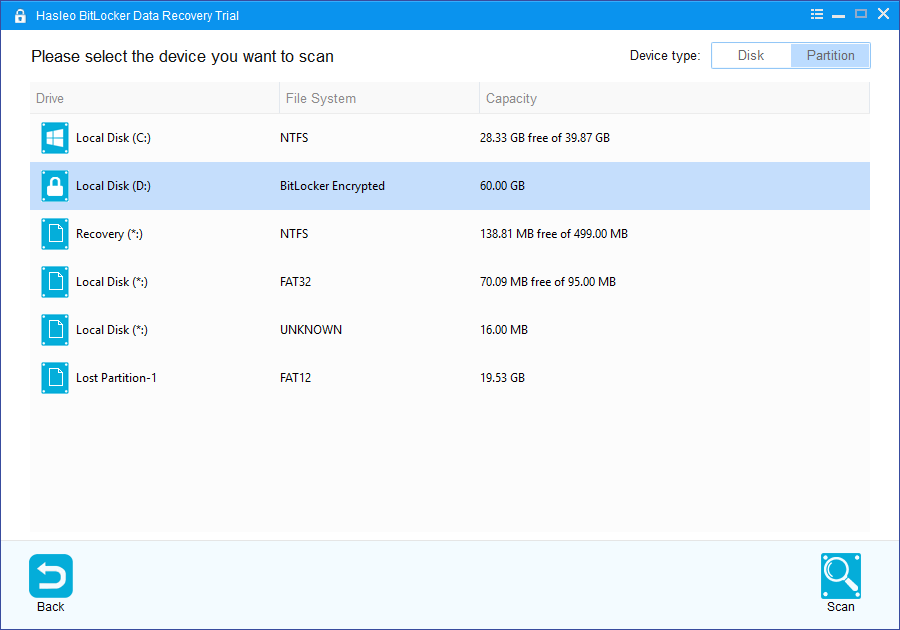
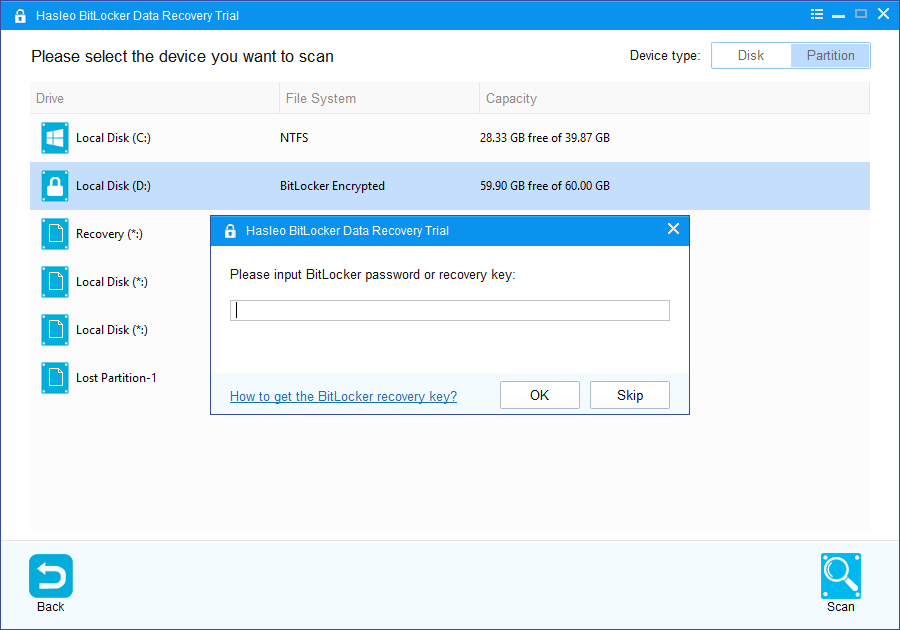
2. A pop-up window will appear asking you to enter the BitLocker password or 48-digit BitLocker recovery key. If you don't want to enter the password or BitLocker recovery key here, just click the "Skip" button to skip it.
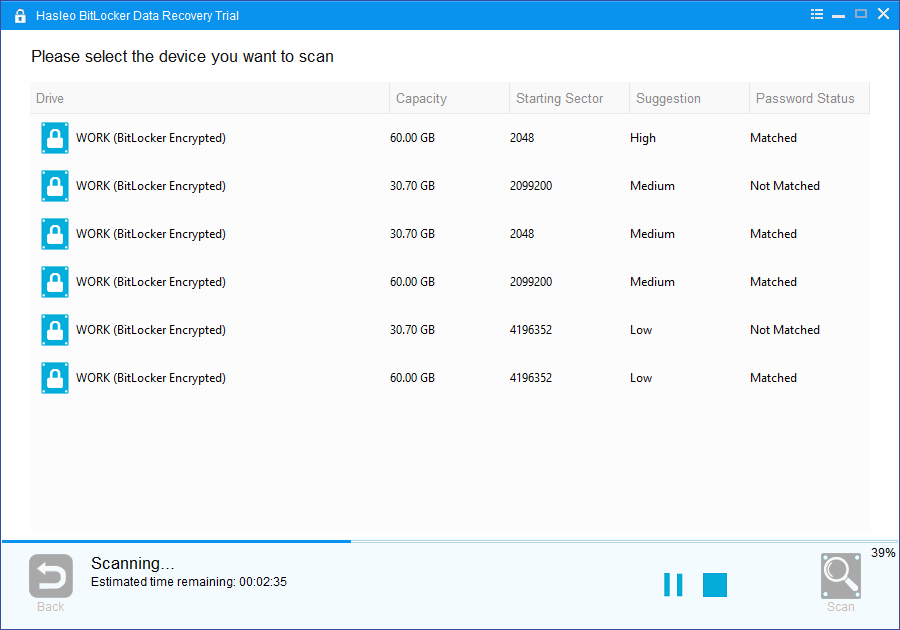
3. Hasleo Data Recovery will list all found BitLocker-encrypted partitions on the formatted device. If you have entered the password or BitLocker recovery key in the previous step, the password status will show whether the password or BitLocker recovery key matches this partition.
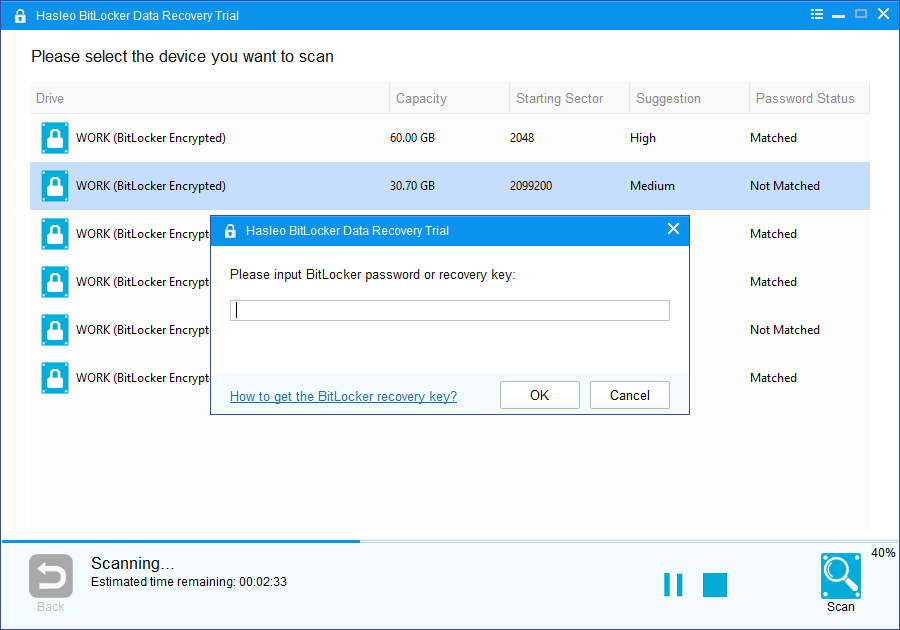
4. Double-click the partition you want to recover data from. If you've already entered the password or BitLocker recovery key and the password or recovery key matches, Hasleo Data Recovery will start scanning lost files. Otherwise, a prompt will appear asking for your BitLocker password or 48-digit recovery key. After entering the correct credentials and clicking "OK", the scan will start.
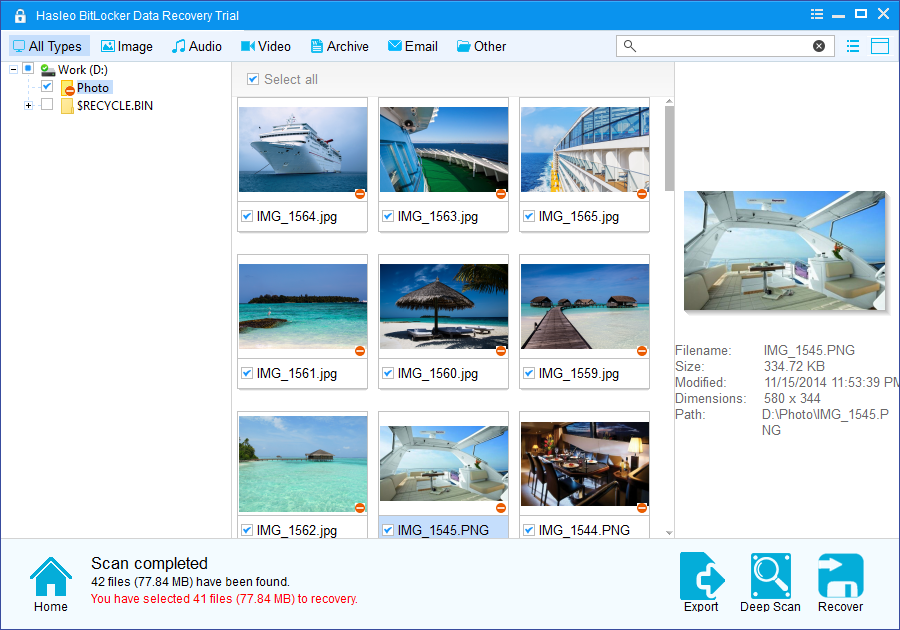
Step 3: Preview and Recover Deleted Files
When the scanning process gets finished, you can filter and preview found files by path and file types. When you locate the files you want, just select them and click on "Recover" button to save them to your hard drive or other storage device. If some files are not found, please click "Deep Scan" button to start the Deep Scan Recovery process, deep scan takes more time, but can find much more lost files.
Frequently Asked Questions (FAQ) for Formatted BitLocker Drive Recovery
A: Yes, you can recover data from a formatted BitLocker-encrypted drive, especially after high-level formatting. The original data often remains in untouched sectors and can be recovered using professional BitLocker data recovery software.
A: High-level formatting only erases file system metadata but does not overwrite user data, making recovery possible. Low-level formatting reinitializes the drive to factory state, making data recovery nearly impossible.
A: Yes, you need either the BitLocker password or the 48-digit recovery key to decrypt and access the data on a formatted BitLocker-encrypted drive. Without these credentials, the data cannot be accessed.
A: Yes, quick format only removes file system information and doesn't overwrite the actual data. You have a higher chance of recovering data from a quickly formatted BitLocker-encrypted drive.
A: If you formatted the drive with the same BitLocker encryption enabled, the original encrypted data may still be partially recoverable in unallocated sectors until new data overwrites it.
A: You should try to recover data as soon as possible. The longer you wait, the higher the chance that new data will overwrite the sectors containing your original files, making recovery impossible.
A: Yes, Hasleo BitLocker Data Recovery can recover data from BitLocker-encrypted drives regardless of the file system (NTFS, FAT32, exFAT, etc.) you formatted it to.
A: Yes, deep scan is recommended for formatted drives as it performs a more thorough search to find recoverable files. It takes more time but significantly increases the chances of recovering more lost data.
Conclusion
Accidentally formatting a BitLocker-encrypted partition can feel like a disaster. This tutorial provides step-by-step instructions on how to recover data from a formatted BitLocker drive using Hasleo BitLocker Data Recovery. With its powerful features and intuitive interface, Hasleo BitLocker Data Recovery stands out as one of the most reliable BitLocker data recovery solutions available.
Hasleo BitLocker Data Recovery can not only recover lost data from formatted BitLocker-encrypted drives, but also from inaccessible, failed, damaged, lost, or deleted BitLocker-encrypted drives. You can even use it to recover data from a BitLocker-encrypted Windows partition after a system crash. Still unconvinced? Give it a try for free!
Related Articles
- How to recover data from BitLocker encrypted drive?
- How to recover data from formatted BitLocker encrypted drive?
- How to recover data from BitLocker encrypted drive in Windows 11/10?
- How to recover files from deleted or lost BitLocker encrypted partition?
- How to recover files from a damaged or corrupted BitLocker encrypted partition?