

- Tutorial to Clone Windows 10 1809 to a USB Drive as a Windows To Go Workspace
- Frequently Asked Questions
- Conclusion
After Microsoft released Windows 10 October 2018 Update (Windows 10 1809), cloning Windows 10 1809 to a USB drive and booting from it will result in the following blue screen error: Stop Code: DRIVER_UNLOADED_WITHOUT_CANCELLING_PENDING_OPERATIONS What failed: dump_WppRecorder.sys
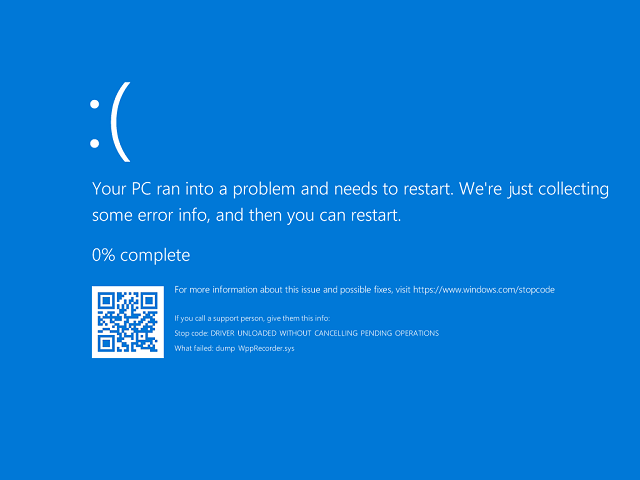
To fix this issue, download and install the latest version of Hasleo WinToUSB, and use it to clone Windows 10 1809 to an external hard drive or a USB flash drive. Then you can resolve Blue Screen Errors (e.g., dump_WppRecorder.sys) by "Driver Unloaded Without Cancelling Pending Operations".
The dump_WppRecorder.sys BSOD was a well-known compatibility issue specific to Windows 10 version 1809 when deployed as a portable Windows To Go workspace. This error occurred because the Windows 1809 boot process attempted to unload the WppRecorder driver without properly cancelling pending I/O operations, a timing-related bug that Microsoft addressed in subsequent Windows 10 releases. Understanding this history helps contextualize why later Windows 10 versions (1903 and newer) provide a more reliable Windows To Go experience without requiring workarounds.
Below we will detail how to use Hasleo WinToUSB to clone Windows 10 1809 to a USB drive as a Windows To Go workspace.
Tutorial to Clone Windows 10 1809 to a USB Drive as a Windows To Go Workspace
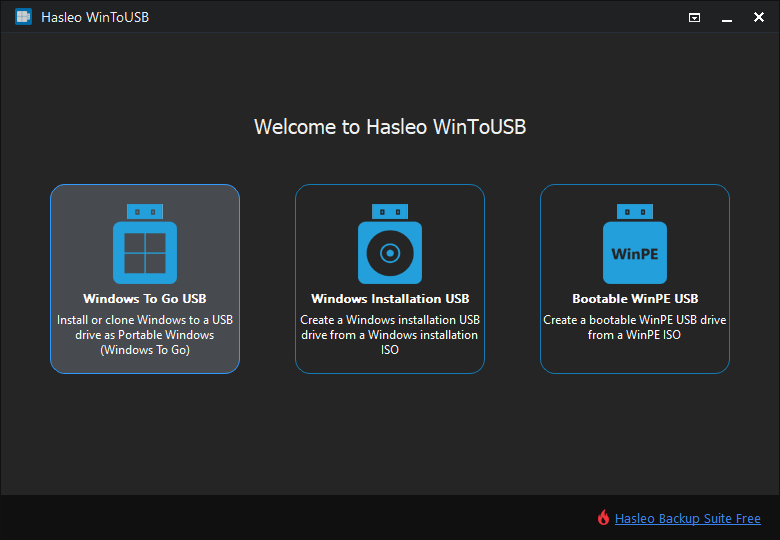
Step 1. Connect the USB drive to your computer. Download, install and run Hasleo WinToUSB, then click the "Windows To Go USB".
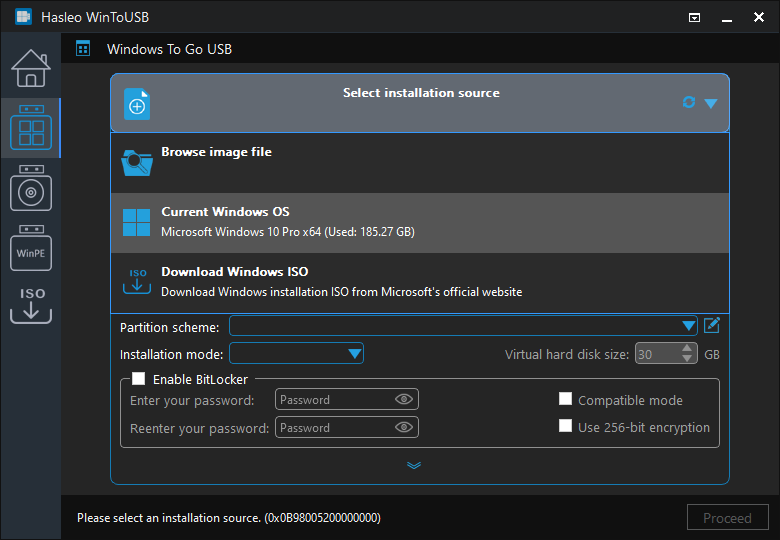
Step 2. Click "Select installation source" and then select "Current Windows OS" from the pop-up list.
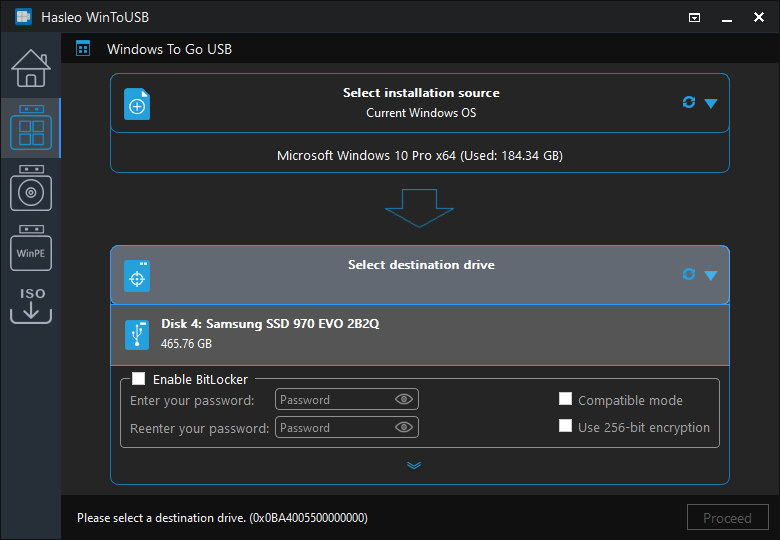
Step 3. Click "Select destination drive" and choose the target drive from the pop-up list.
Step 4. Select your preferred partition scheme and installation mode. Optionally, you may specify additional drivers or enable BitLocker encryption for the Windows To Go drive, then click "Proceed".
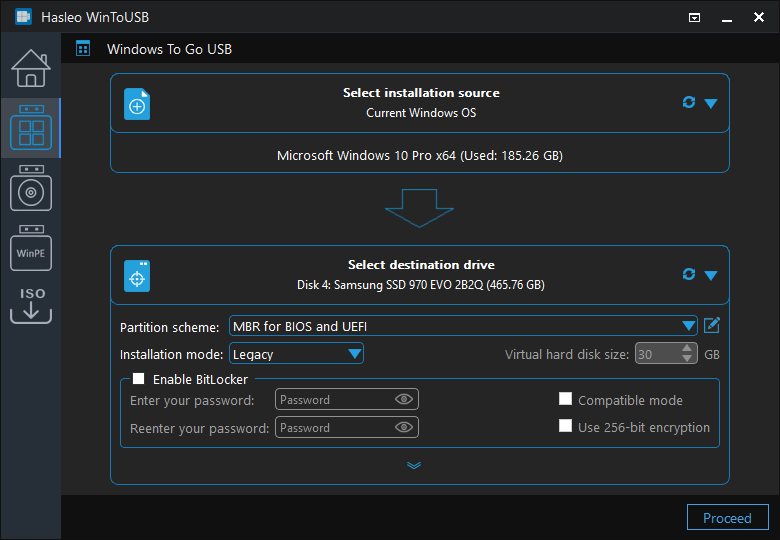
* Tips: For detailed information about "Partition scheme", "Installation mode" and "Enable BitLocker", please refer to: How to Clone an Existing Windows to a USB Drive as a Windows To Go Workspace?
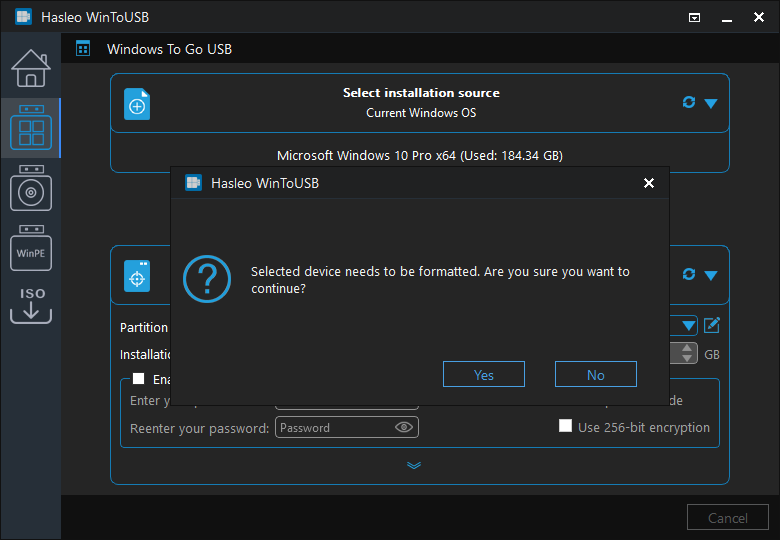
Step 5. After clicking "Proceed", a confirmation dialog will appear asking whether to continue formatting the drive. Click "Yes" if you accept the operation.
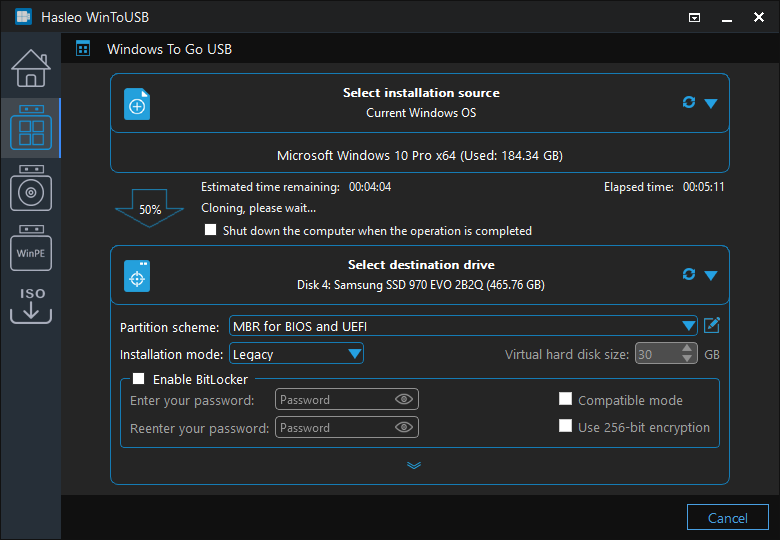
Step 6. After clicking "Yes", Hasleo WinToUSB initiates Windows cloning on the destination drive. Cloning time depends on the size of the data being cloned.
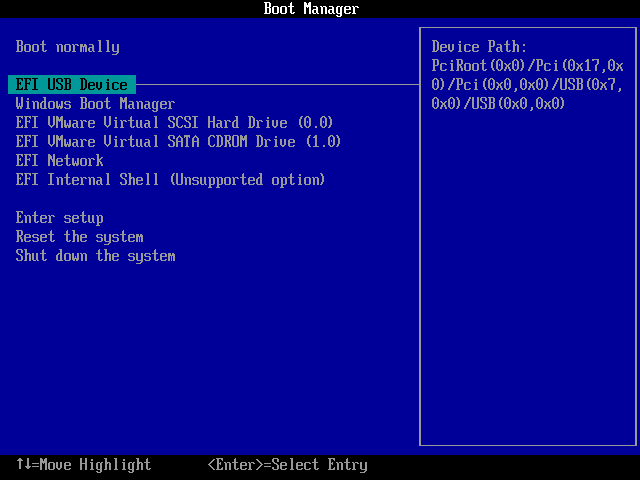
Step 7. Wait for the cloning process to finish. Upon successful completion, restart the computer and enter UEFI/BIOS settings to boot from the USB flash drive.
Frequently Asked Questions
A: Windows 10 1809 may show the error DRIVER_UNLOADED_WITHOUT_CANCELLING_PENDING_OPERATIONS (dump_WppRecorder.sys) when cloned. Using the latest version of WinToUSB resolves this issue.
A: Hasleo WinToUSB is a reliable tool to clone Windows 10 1809 to USB drives. It fixes the BSOD issues that occur with other cloning methods.
A: Yes, WinToUSB supports cloning all editions of Windows 10 1809 including Home, Professional, and Enterprise to USB drives.
A: For BIOS and UEFI computers, select MBR for BIOS and UEFI. For UEFI-only computers, select GPT for UEFI. You can enable BitLocker during the cloning process.
A: Yes, besides cloning, WinToUSB also supports installing Windows 10 1809 directly from an ISO file to a USB drive.
Conclusion
Following these steps, you can clone Windows 10 1809 to a USB drive as a Windows To Go, compatible with Home, Professional, and Enterprise editions. As a professional Windows To Go Creator, Hasleo WinToUSB also supports installing Windows 10 1809 to USB drives. While Windows 10 1809 was a significant release that introduced the dump_WppRecorder.sys compatibility challenge, later Windows 10 versions and Windows 11 have resolved this issue entirely. For new Windows To Go deployments, we recommend using a currently supported Windows version to ensure the best compatibility, security, and performance.


