

- Overview of Windows 11 and Windows 10
- Is it possible to clone Windows 11/10 to a USB drive and boot it from the drive?
- Tutorial to clone Windows 11/10 to a USB drive as a portable Windows using Hasleo WinToUSB
- How to set up and run a portable Windows 11/10 system on different computers?
- Troubleshooting Common Issues
- Frequently Asked Questions
- Conclusion
Are you looking for a tool to clone Windows 11/10 to create a portable system? This tutorial will detail how to clone Windows 11/10 to a USB drive as portable Windows using Hasleo WinToUSB.
Overview of Windows 11 and Windows 10
Windows 10 was officially released on July 29, 2015. After several years of updates, it remains one of the most widely used Windows versions. Windows 10 offers six editions: Home, Professional, Enterprise, Education, Pro for Workstation, and IoT Core Edition. However, most users use Home, Professional, and Enterprise. Windows 10 has greatly improved usability and security while integrating new technologies like cloud services, intelligent mobile devices, and natural human-computer interaction. It has also enhanced support for hardware such as SSDs, biometric technology, and high-resolution screens. From a technical point of view, Windows 10 is an excellent consumer OS, which is the key to its success.
Windows 11, released by Microsoft in October 2021, represents a significant evolution of the desktop operating system, built to deliver a secure, modern, and efficient user experience. It retains the familiar, robust functionality users rely on while introducing a range of innovative features designed for today's hybrid work and lifestyle environments, with a focus on enhancing productivity, connectivity, and ease of use. Notable advancements include a centered Start menu and taskbar, integrated Microsoft Teams Chat, Snap Layouts for streamlined multitasking, direct Android app support via the Amazon Appstore, and performance improvements such as faster wake times and better efficiency on compatible hardware. According to Statcounter data as of February 2026, Windows 11 has achieved a global market share of 72.6%, marking a record high and reflecting its widespread adoption since launch.
As of early 2026, although mainstream support for Windows 10 ended on October 14, 2025, Microsoft continues to provide security updates through the Extended Security Updates (ESU) program until October 13, 2026. During this period, Windows 10 maintains a substantial global installed base. According to Statcounter, approximately 26.4% of personal computers worldwide still run Windows 10, particularly in organizations and markets with longer hardware refresh cycles or higher demands for system stability and continuity.
Is it possible to clone Windows 11/10 to a USB drive and then boot it from the drive?
Yes, cloning your current Windows 11 or 10 installation to a USB drive and booting directly from it is entirely feasible with the right tools. This capability is especially valuable for IT professionals, system administrators, and anyone who needs a portable workstation. To achieve this, two key technical challenges must be addressed: whether Windows 11/10 can boot from a USB drive, and whether an existing Windows installation can be cloned to a USB drive while remaining fully bootable.
The solution lies in a combination of a native Windows feature and a dedicated tool:
* Windows To Go is a Microsoft feature designed to allow Windows 11/10 to boot and run directly from a USB drive.
* Hasleo WinToUSB is a specialized utility developed by Hasleo. It can clone your existing Windows 11/10 installation onto a USB drive and automatically configure it as a Windows To Go workspace, thereby creating a fully functional, portable Windows system.
In the guide below, we will detail the step-by-step process of how to clone Windows 11/10 to a USB drive as a Portable Windows with the help of Hasleo WinToUSB.
Tutorial to Clone Windows 11/10 to a USB Drive as a Portable Windows Using Hasleo WinToUSB
Step 1. Connect the USB drive to your computer. Download, install and run Hasleo WinToUSB, then click the "Windows To Go USB".
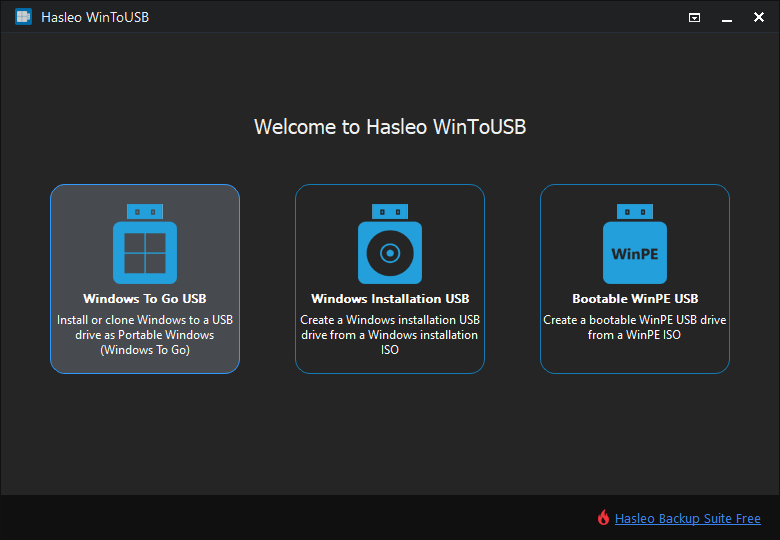
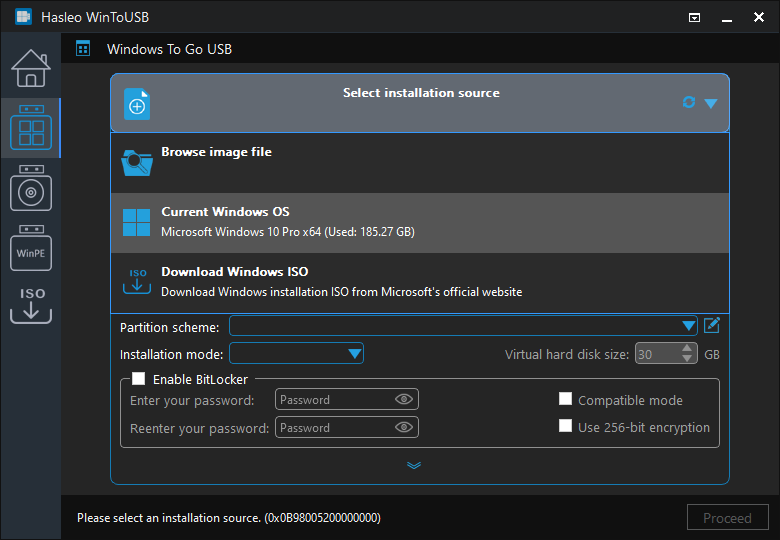
Step 2. Click "Select installation source" and then select "Current Windows OS" from the pop-up list.
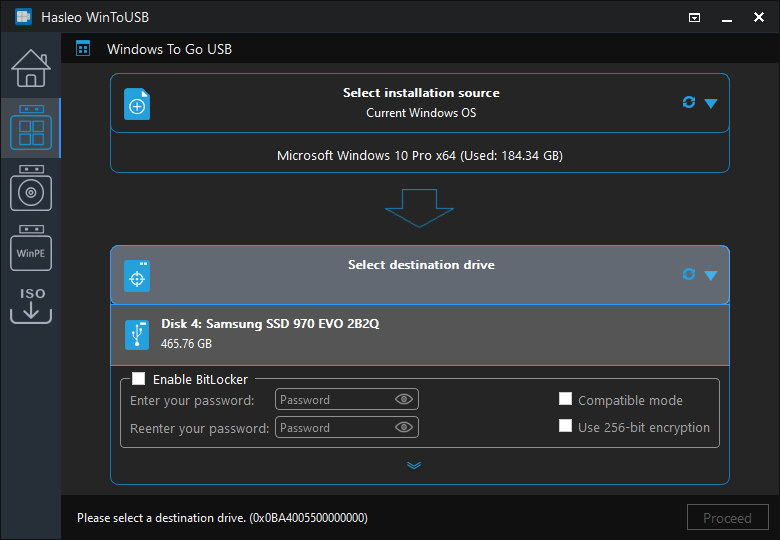
Step 3. Click "Select destination drive" and choose the target drive from the pop-up list.
Step 4. Select your preferred partition scheme and installation mode. Optionally, you may specify additional drivers or enable BitLocker encryption for the Windows To Go drive, then click "Proceed".
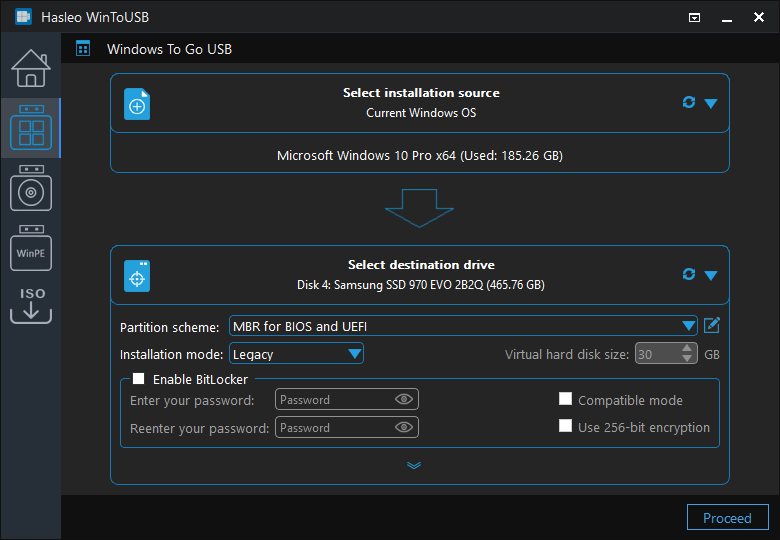
• For detailed information about "Partition scheme", "Installation mode" and "Enable BitLocker", please refer to: How to Clone an Existing Windows to a USB Drive as a Windows To Go Workspace?
Step 5. After clicking "Proceed", a confirmation dialog will appear asking whether to continue formatting the drive. Click "Yes" if you accept the operation.
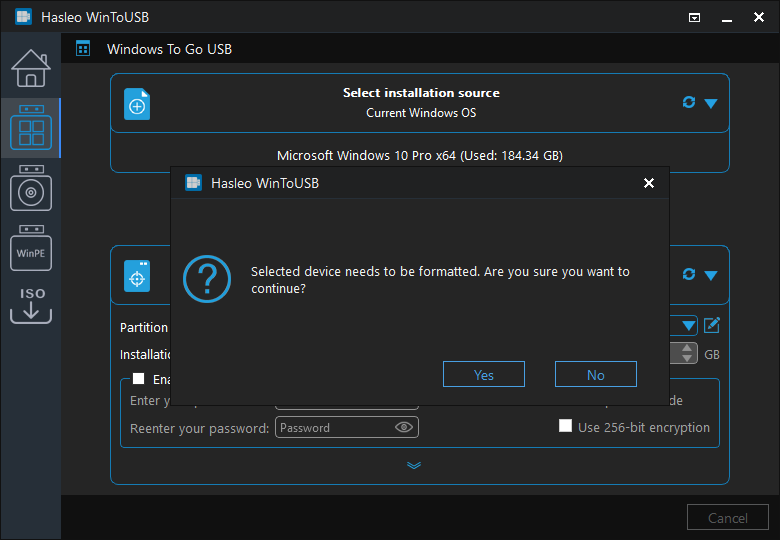
Step 6. After clicking "Yes", WinToUSB initiates Windows cloning on the destination drive. Cloning time depends on the size of the data being cloned.
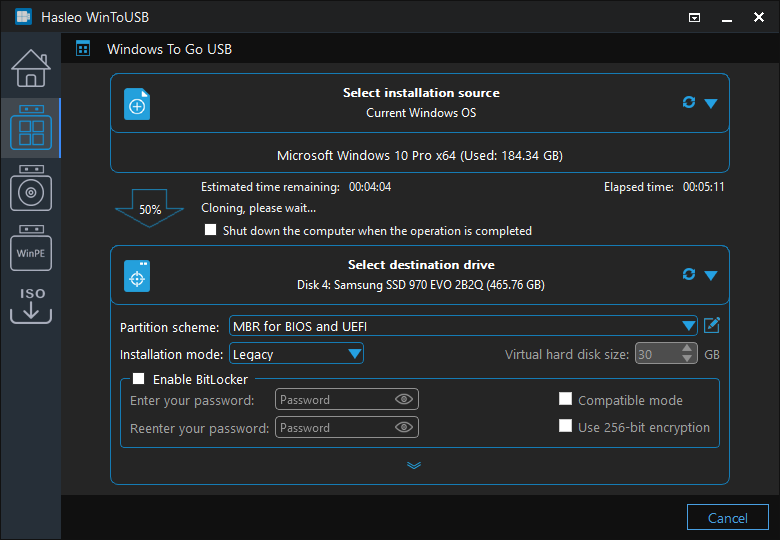
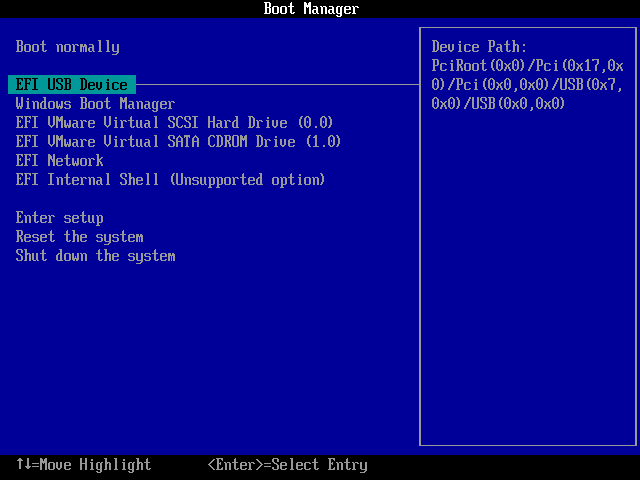
Step 7. Wait for the cloning process to finish. Upon successful completion, restart the computer and enter UEFI/BIOS settings to boot from the USB drive.
How to set up and run a portable Windows 11/10 system on different computers?
The portable Windows 11/10 created by Hasleo WinToUSB can run on different computers. By default, most computers boot from the internal disk. To boot a computer from a USB drive, you should enter the UEFI/BIOS settings to set the USB as the first boot device.
Here's how to enter the computer's UEFI/BIOS. If you are familiar with computer technology, you know that you can enter the UEFI/BIOS by pressing a specific key when the computer is powered on. The following diagram displays BIOS/UEFI access keys for popular computer manufacturers and common motherboard brands.
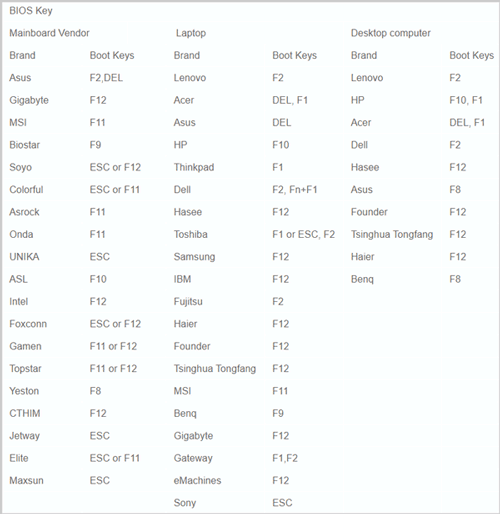
If your motherboard or computer is not listed in the table above or the keys do not work, check your motherboard or computer manual to find the correct key, or contact the manufacturer for help. Here are the detailed steps to enter the UEFI/BIOS and change the boot order, then boot from the USB:
Step 1. Connect the USB to the computer and turn it on. Then immediately press the specific key to enter UEFI/BIOS.
Step 2. After accessing the BIOS/UEFI interface, change the boot order to set your Windows 11/10 To Go USB drive first.
Step 3. Save the UEFI/BIOS settings and restart the computer. The system will boot Windows 11/10 from the USB drive.
Troubleshooting Common Issues
This error indicates a file system issue on your Windows partition (usually C:). Run chkdsk to scan and repair it:
- Open Command Prompt as administrator
- Run the command:
chkdsk C: /F /X - If prompted to schedule the scan on next reboot, type
Yand restart your computer - After the scan completes, launch WinToUSB and try the cloning process again
This error means the target drive is too small to clone your Windows installation to it. The USB drive must be larger than the used space on your current Windows partition. Use a larger drive (at least 64GB recommended for typical Windows installations, or larger if your system has many applications and files).
The last 8 characters of the error code shown by Hasleo WinToUSB correspond to the error code returned by the Windows kernel. 0x1B1 (A device which does not exist was specified.) typically means the disk was unexpectedly disconnected or went offline automatically. Try the following:
- Replace the data cable or enclosure
- Connect an external power supply to the USB drive
- Reconnect the USB drive or use a different USB port
- Perform the cloning operation on another computer
The last 8 characters of the error code returned by Hasleo WinToUSB ending in 00000005 correspond to Windows error code 0x5 (Access is denied.) — this means the system denied write access to the drive. This is typically caused by antivirus software blocking the write operation. Try temporarily disabling your antivirus or adding WinToUSB to the exclusion list before retrying.
The speed of a USB 2.0 drive is very slow and is not suitable for creating Windows To Go. Please use a USB 3.0/3.1 drive or an external SSD and connect the USB drive to the computer's USB 3.0/3.1 port for better performance. Normally, the cloning process only takes a few minutes, depending on the drive speed and Windows version.
Frequently Asked Questions
A: Yes, WinToUSB supports cloning both Windows 10 and Windows 11 to a USB drive as portable Windows. Both Home and Professional editions are supported.
A: Cloning time depends on the size of data being cloned. Larger Windows installations with many applications will take longer. The process runs in the background.
A: Yes, the portable Windows created by WinToUSB can run on different computers. You need to change the boot order in UEFI/BIOS to set the USB as the first boot device.
A: Yes, WinToUSB supports BitLocker encryption. You can enable this option during the cloning process to protect your data on the portable drive.
A: For most computers, use MBR for BIOS and UEFI. For UEFI-only computers, use GPT for UEFI. The correct partition scheme ensures the drive boots properly.
Conclusion
Cloning Windows 11/10 to a USB drive with Hasleo WinToUSB is a straightforward process that gives you a fully portable Windows workspace—complete with your applications, settings, and files—ready to use on any compatible computer. Whether you need an emergency backup, a consistent work environment across multiple machines, or a dedicated system for specific tasks, cloning preserves everything exactly as-is without reinstalling.
Hasleo WinToUSB supports creating portable systems from Windows 11, 10, and 8, and can also install Windows from ISO files to a USB drive if you prefer a fresh installation.
Pro tip: For the best performance and user experience, we strongly recommend using an external SSD.


