

- Tutorial to Install and Run Windows 10 from a USB Flash Drives
- Frequently Asked Questions
- Conclusion
I have been using Windows 10 To Go for over a year in the company, and it's really handy, so I'm going to use it in a non work related environment. In the company, we use the Windows To Go certified drive to create Windows 10 To Go, the price of Windows To Go certified drive is a bit expensive for me. I also feel that the size of the external hard drive is a bit large, so I want to install and run Windows 10 from a USB flash drive. Is this possible? If it is then please tell me how. Thanks.
Microsoft's Windows To Go Creator Wizard tool does not support installing and running Windows 10 from USB flash drives. Hasleo WinToUSB, the world's first third-party Windows To Go creation software, has been developed that allows you to install and run Windows 10 from USB flash drives. It is easy to use and ensures that created portable Windows 10 drive can boot successfully on both Legacy BIOS and UEFI computers.
Tutorial to Install and Run Windows 10 from a USB Flash Drives.
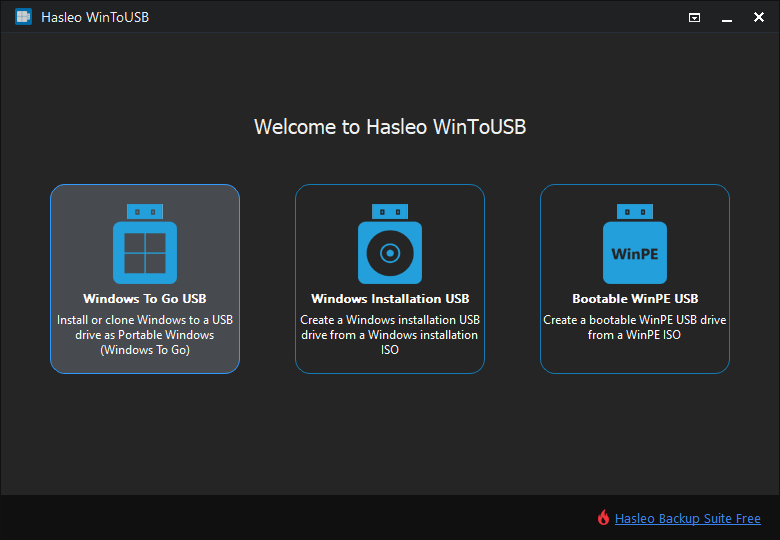
Step 1. Connect the USB flash drive to your computer, then download, install, and run Hasleo WinToUSB. Click the "Windows To Go USB" option.
Step 2. Click "Select installation source", then click "Browse image file". Then choose the Windows 10 installation ISO file from the dialog box as installation source. Alternatively, select a CD/DVD drive with Windows 10 installation media.
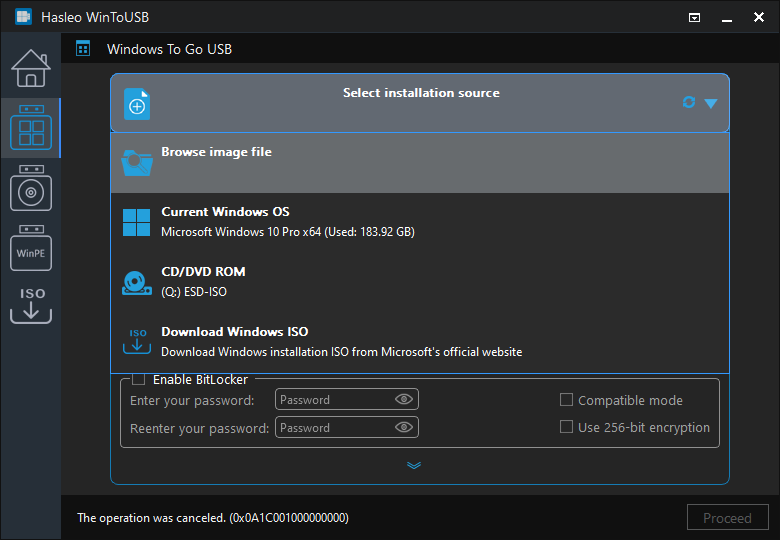
* Tips: If you don't have a Windows 10 installation ISO, please download it first.
Step 3. Hasleo WinToUSB will scan for and list the available Windows editions. Please select the edition you want to install.
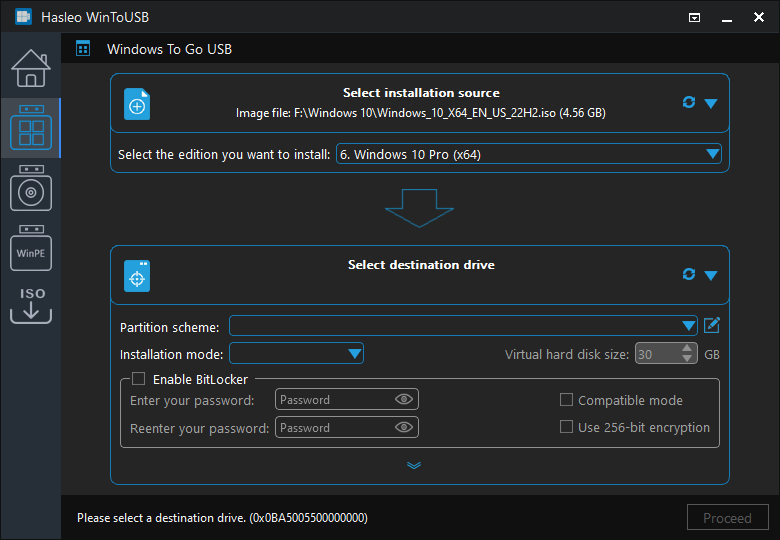
Step 4. Click "Select destination drive", then choose the target drive from the pop-up list. If Hasleo WinToUSB fails to detect the drive, click the  button to initiate drive recognition.
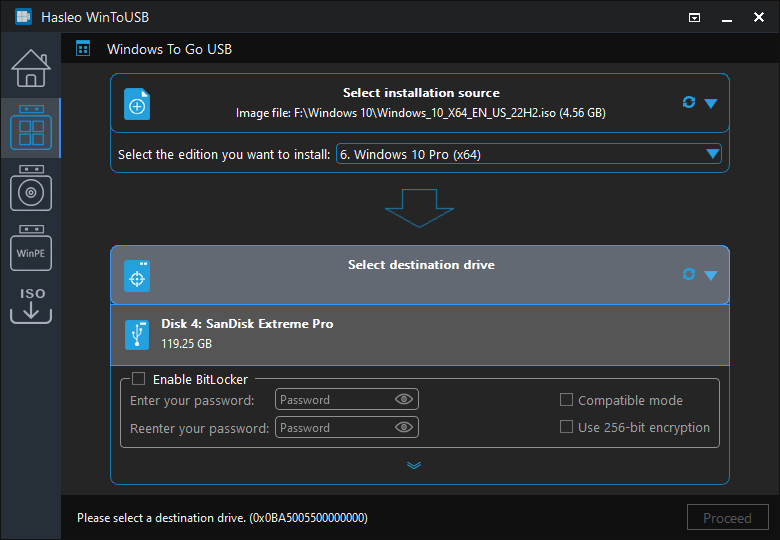
Step 5. Select your preferred partition scheme and installation mode. Optionally, you may specify additional drivers or enable BitLocker encryption for the Windows To Go drive, then click "Proceed".
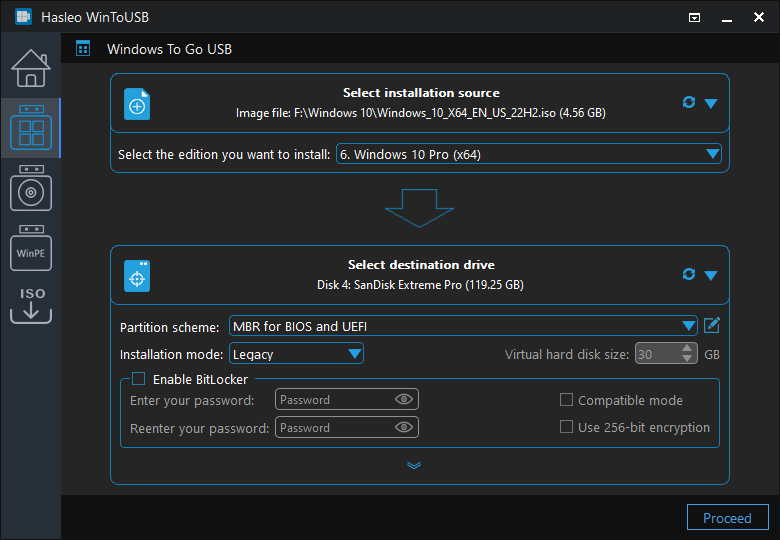
* Tips:
- We recommend choosing the VHD/VHDX installation mode for better compatibility when creating a Windows To Go on a USB flash drive.
- For detailed information about "Partition scheme", "Installation mode" and "Enable BitLocker", please refer to: How to Create Portable Windows 11/10/8/7 from ISO, WIM, ESD, SWM, VHD(X) or DBI Files?
- If you select "Keep the existing partition scheme" option, you need to manually prepare the USB drive partitions before this step. View guide: How to Manually Prepare Partitions for Windows To Go.
Step 6. After clicking "Proceed", a confirmation dialog will appear asking whether to continue formatting the drive. Click "Yes" if you accept the operation.
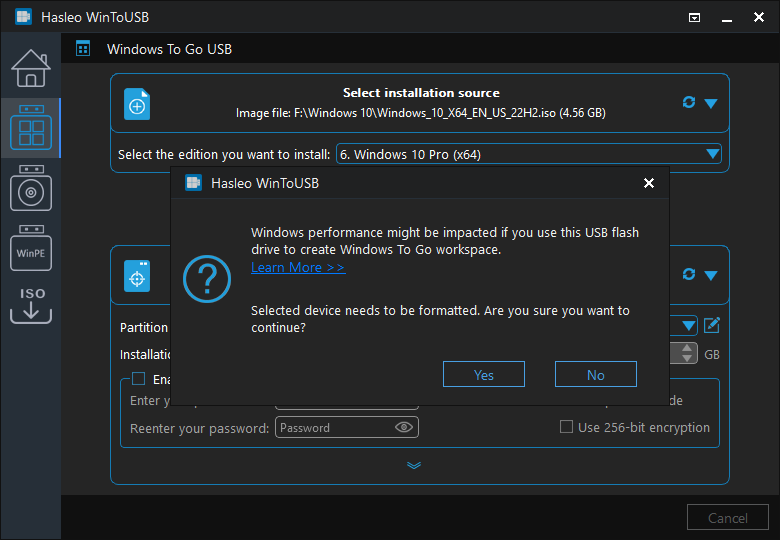
Step 7. After clicking "Yes", WinToUSB initiates Windows installation on the destination drive.
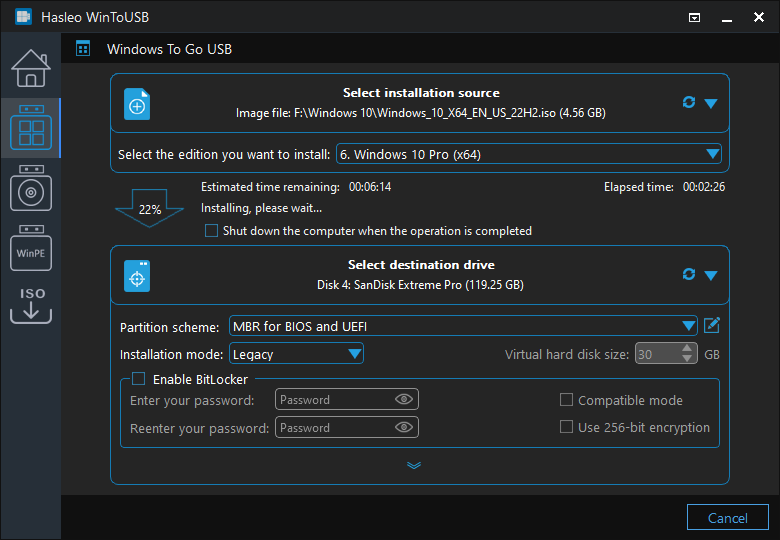
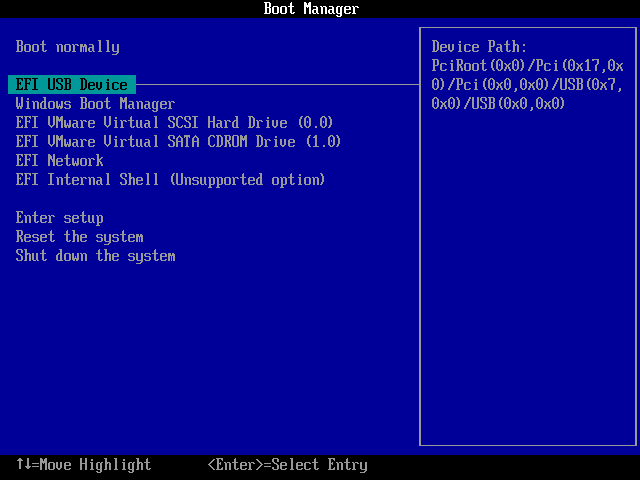
Step 8. The installation will take some time. After installation, restart the computer and enter UEFI/BIOS settings to boot from the USB drive.
Step 9. A standard Windows 10 installation requires completing all setup steps during the first boot. Afterward, you can install applications and copy files, etc.
Frequently Asked Questions
A: Windows 10 requires at least 20GB of storage, but we recommend using a USB flash drive with 64GB or more for comfortable use. Larger drives provide better performance and more space for Windows updates and applications.
A: We recommend USB 3.0 or faster flash drives for acceptable performance. USB 2.0 drives will be very slow. Using VHD mode is recommended for better compatibility with USB flash drives.
A: VHD mode creates a virtual hard disk file on the USB drive, offering easier backup and restoration of the Windows environment. It provides better compatibility and allows you to manage the Windows installation more flexibly.
A: Performance depends on the USB flash drive speed. High-quality USB 3.0 flash drives can provide acceptable performance, but they are generally slower than internal SSDs or external hard drives.
A: Yes, when creating the Windows To Go, you can select 'MBR for BIOS and UEFI' partition scheme. This allows the portable Windows 10 to boot on both Legacy BIOS and UEFI computers.
Conclusion
Following these steps, you can install and run Windows 10 on USB flash drives easily. As the world's first third-party Windows To Go creator software, Hasleo WinToUSB can not only install and run Windows 10 from USB flash drives, but also supports installing Windows 10 on external drives as Windows To Go.
Related Guides
- How to create a portable Windows 11/10 USB drive?
- How to create Windows 10 To Go without an enterprise edition of Windows 10?
- How to install Windows 10 to an external hard drive as portable Windows 10?
- How to clone Windows 10 to an external hard drive as portable Windows 10?
- How to run Windows 10 from an external hard drive?


